Welsh Onion Bulb
- Chinese
- 葱白
- Pinyin
- Cong Bai
- Latin
- Bulbus Allii Fistulosi
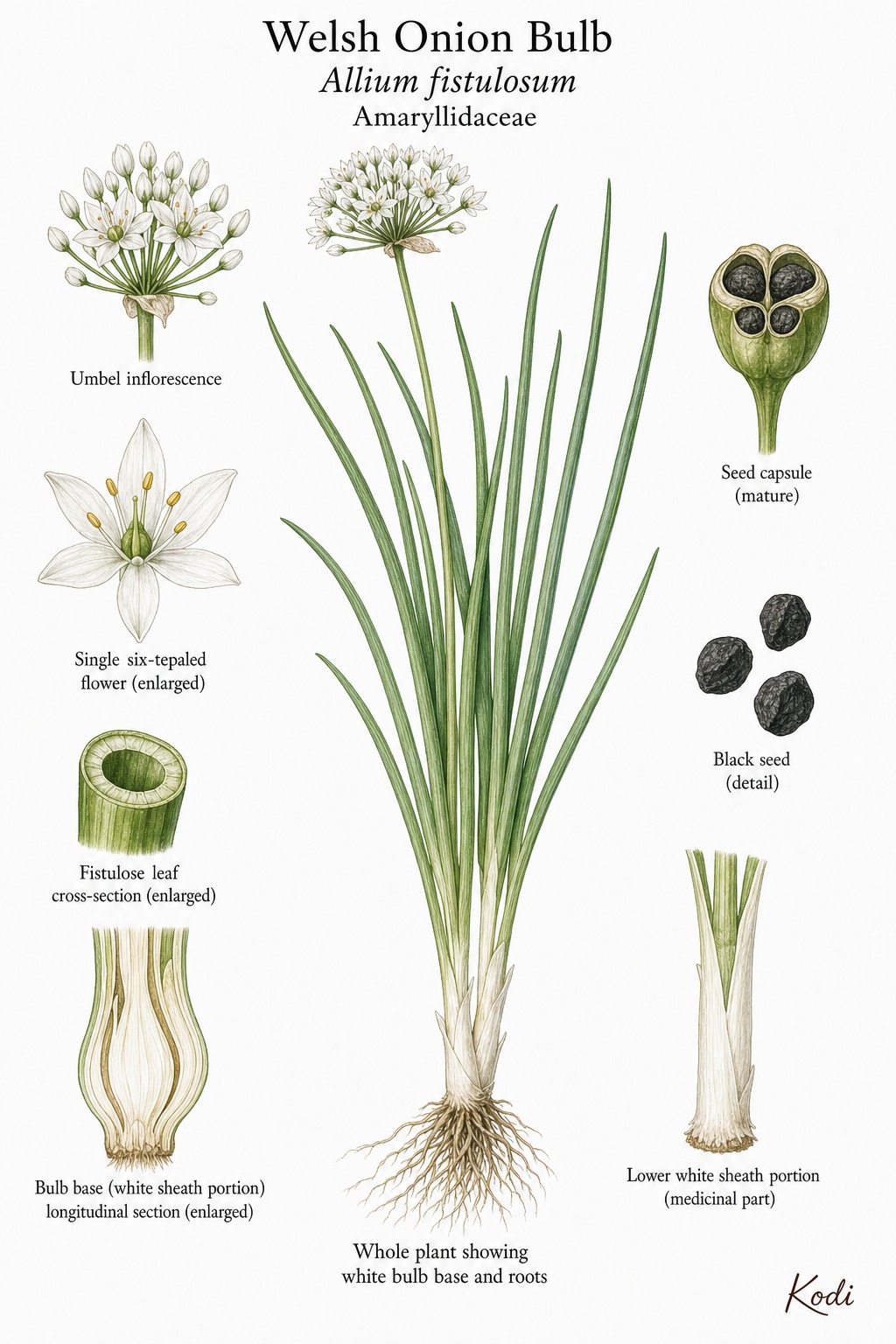
Known in TCM as Cong Bai (葱白), this pungent, warm herb enters the Lung and Stomach. Traditionally, it releases exterior and dispels Wind-Cold, most often applied for common cold, abdominal pain, and carbuncle. Modern research has identified Allicin among its active constituents.
Part used: Bulb
Also Known As
Latin: Bulbus Allii Fistulosi | Pinyin: Cong Bai | Chinese: 葱白
TCM Properties
- Taste
- pungent
- Temperature
- warm
- Channels
- Lung, Stomach
Traditional Use
Primary Actions
- Releases exterior and dispels Wind-Cold … mild exterior-releasing herb for early-stage wind-cold colds with chills, fever, headache, and nasal congestion; especially appropriate when there is no sweating
- Invigorates Yang and disperses Cold … abdominal pain, cold limbs, and nausea from Cold accumulation in the Stomach and lower abdomen; Yi Yang Jiu Ni (revolve Yang to rescue counterflow)
- Resolves toxicity and reduces swelling … mastitis, carbuncles, and abscesses; applied fresh topically
Secondary Actions
- Promotes urination … dysuria from Cold obstruction; classical use with salt as an umbilical compress for retention of urine
- Edible medicinal food … the white lower portion of Allium fistulosum (Welsh onion / bunching onion) consumed daily as a vegetable; recognised as a kitchen medicine across all of Chinese culinary tradition
Classic Formulas
- Cong Chi Tang (葱豉汤) … classical two-herb formula for mild Wind-Cold exterior pattern; Cong Bai combined with Dan Dou Chi (fermented black soybeans); induces mild sweating to release Wind-Cold; from Zhou Hou Bei Ji Fang (Ge Hong); first-line folk remedy for early cold with runny nose and chills
- Bai Tong Tang (白通汤) … classical formula for severe Yang deficiency with cold counterflow; Cong Bai combined with Fu Zi (processed aconite) and Gan Jiang (dry ginger); used in serious cold-collapse patterns requiring urgent Yang restoration
Classical References
- Shen Nong Ben Cao Jing: lists Cong Shi (葱实, onion seeds) in the middle grade, with the stalk and white base noted for 'making the eyes bright, tonifying deficiency, and killing pestilential Qi' … Cong Bai (the white bulb base) is specifically valued for exterior-releasing properties in all subsequent materia medica
- Ben Cao Gang Mu (Li Shizhen): 'Cong Bai (white green onion) releases the exterior, disperses wind-cold, opens the pores, and invigorates Yang … it is warm but gentle, appropriate for the weak patient who cannot tolerate stronger dispersing herbs; used fresh externally for swollen sores and mastitis'
Modern Research
Active Compounds
- Allicin and diallyl disulfide (organosulfur compounds; antimicrobial, anti-inflammatory, cardioprotective)
- Quercetin and quercetin-3,4'-diglucoside (flavonoids; anti-inflammatory, antioxidant, cardioprotective)
- Fructo-oligosaccharides (prebiotic polysaccharides; gut microbiome support)
- Kaempferol glycosides (flavonoids; anti-inflammatory)
- Vitamin C and folate (micronutrients; antioxidant, immune support)
- Cycloalliin (organosulfur; mild antithrombotic)
Studied Effects
- Antimicrobial: allicin from Allium fistulosum demonstrates broad-spectrum antimicrobial activity against respiratory and gastrointestinal pathogens including Streptococcus pneumoniae, Haemophilus influenzae, Staphylococcus aureus, and Escherichia coli; mechanism involves thiol-alkylation of bacterial enzymes … validates the exterior-releasing, anti-infective folk application for early upper respiratory infection
- Cardiovascular: quercetin and organosulfur compounds from A. fistulosum reduce platelet aggregation, inhibit LDL oxidation, and demonstrate mild ACE-inhibitory antihypertensive activity in in vitro and animal studies … consistent with daily culinary use as a cardiovascular protective food in Chinese dietary medicine
- Anti-inflammatory: quercetin and kaempferol glycosides inhibit NF-κB and COX-2 in macrophage models; the anti-inflammatory activity is modest but meaningful at daily dietary doses, supporting the classification as a food-medicine for mild inflammatory and infectious conditions
Safety & Interactions
Contraindications
- Wind-Heat exterior patterns (fever with sweating, sore throat, yellow phlegm) … pungent-warm nature inappropriate for Heat-type exterior conditions
- Excess sweating patterns … further pore-opening would deplete fluids
Cautions
- Standard dose: 3–5 stalks (white part, 6–9 cm) in decoction; external use: roasted bulb applied to skin for mastitis and carbuncle
- Anticoagulants (warfarin, aspirin, clopidogrel): cycloalliin and quercetin have mild antiplatelet effects; significant only at pharmacological doses far above culinary use; monitor in high-dose prolonged use
- Raw Cong Bai may cause gastric irritation in patients with gastric ulcer or sensitive stomach; cooking reduces this effect
- Considered safe at culinary and traditional therapeutic doses; classified as a food herb (shi yao 食药) with negligible systemic risk
Conditions
- Common Cold Traditional ★★★★☆ JSON
- Abdominal Pain Traditional ★★★☆☆ JSON
- Carbuncle Traditional ★★★☆☆ JSON
- Mastitis Traditional ★★★☆☆ JSON
Frequently Asked Questions
What is Welsh Onion Bulb used for?
Welsh Onion Bulb is traditionally used to Releases exterior and dispels Wind-Cold … mild exterior-releasing herb for early-stage wind-cold colds with chills, fever, headache, and nasal congestion; especially appropriate when there is no sweating, Invigorates Yang and disperses Cold … abdominal pain, cold limbs, and nausea from Cold accumulation in the Stomach and lower abdomen; Yi Yang Jiu Ni (revolve Yang to rescue counterflow), Resolves toxicity and reduces swelling … mastitis, carbuncles, and abscesses; applied fresh topically. Research has investigated its effects on: Antimicrobial: allicin from Allium fistulosum demonstrates broad-spectrum antimicrobial activity against respiratory and gastrointestinal pathogens including Streptococcus pneumoniae, Haemophilus influenzae, Staphylococcus aureus, and Escherichia coli; mechanism involves thiol-alkylation of bacterial enzymes … validates the exterior-releasing, anti-infective folk application for early upper respiratory infection; Cardiovascular: quercetin and organosulfur compounds from A. fistulosum reduce platelet aggregation, inhibit LDL oxidation, and demonstrate mild ACE-inhibitory antihypertensive activity in in vitro and animal studies … consistent with daily culinary use as a cardiovascular protective food in Chinese dietary medicine.
What are other names for Welsh Onion Bulb?
Welsh Onion Bulb is also known as Allium. In TCM: 葱白 (Cong Bai); Bulbus Allii Fistulosi.
Is Welsh Onion Bulb safe during pregnancy?
Welsh Onion Bulb is generally considered safe during pregnancy in normal amounts. Therapeutic or concentrated doses should be discussed with a qualified healthcare provider before use.
What are the contraindications for Welsh Onion Bulb?
Welsh Onion Bulb should not be used in: Wind-Heat exterior patterns (fever with sweating, sore throat, yellow phlegm) … pungent-warm nature inappropriate for Heat-type exterior conditions; Excess sweating patterns … further pore-opening would deplete fluids. Consult a qualified healthcare provider before use.