Hairy Vein Agrimony
- Chinese
- 仙鹤草
- Pinyin
- Xian He Cao
- Latin
- Herba Agrimoniae
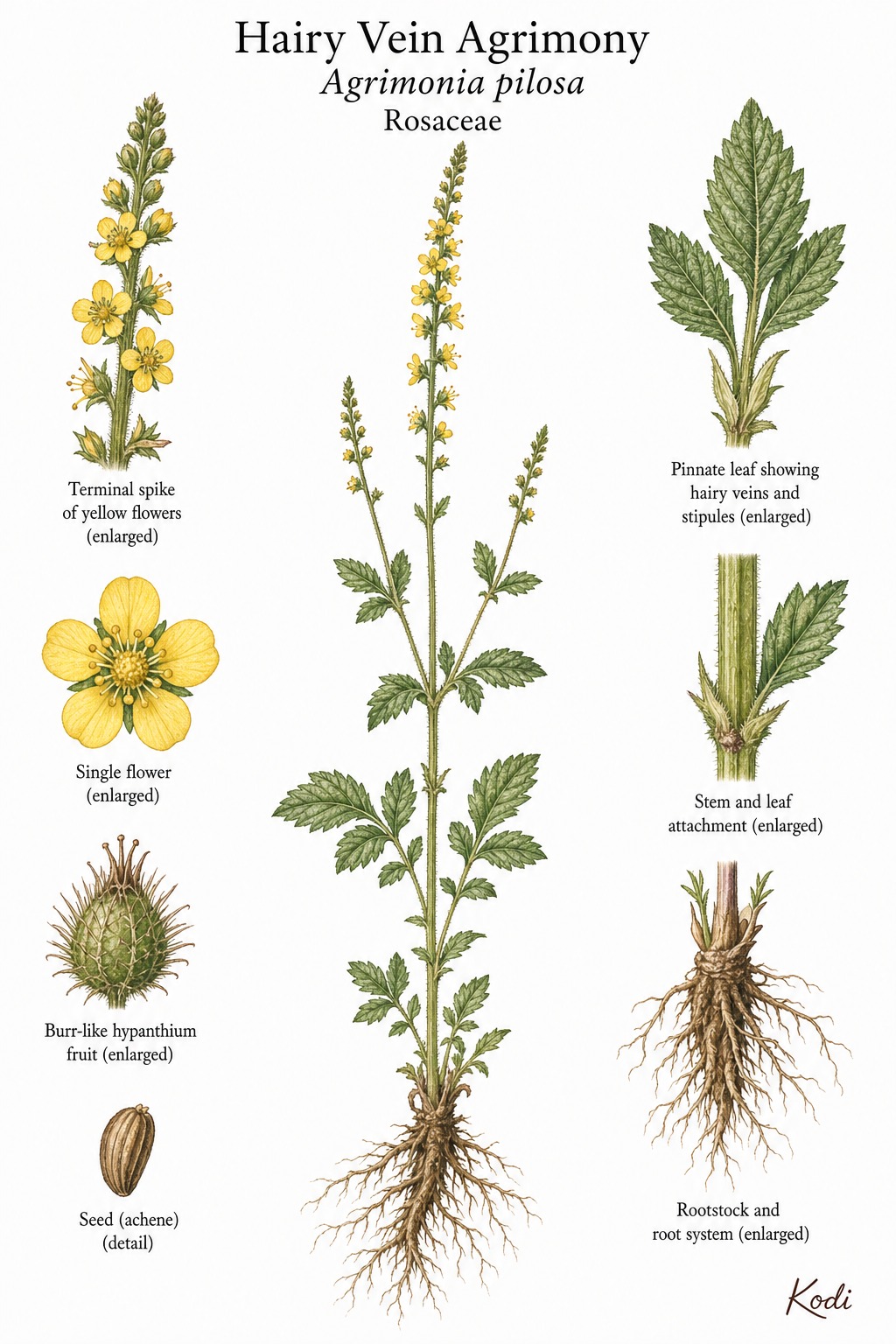
Known in TCM as Xian He Cao (仙鹤草), this bitter and sour, neutral herb enters the Lung, Liver, and Spleen. Traditionally, it astringes to stop bleeding in many locations - classically used for hemoptysis, hematemesis, epistaxis, uterine bleeding, blood in the stool, and chronic leaking-type hemorrhage when a neutral hemostatic that can be used in both Heat and deficiency contexts is needed, most often applied for abnormal uterine bleeding, dysentery, and fatigue. Modern research has identified Agrimonolide among its active constituents.
Part used: Whole herb
Also Known As
Latin: Herba Agrimoniae | Pinyin: Xian He Cao | Chinese: 仙鹤草
TCM Properties
- Taste
- bitter, sour
- Temperature
- neutral
- Channels
- Lung, Liver, Spleen
Traditional Use
Primary Actions
- Astringes to stop bleeding in many locations - classically used for hemoptysis, hematemesis, epistaxis, uterine bleeding, blood in the stool, and chronic leaking-type hemorrhage when a neutral hemostatic that can be used in both Heat and deficiency contexts is needed.
- Stops dysentery and secures the intestines - chosen for chronic diarrhea, bloody dysentery, and lingering intestinal leakage patterns in which Damp-Heat or weakness has damaged the bowel's ability to contain fluids and blood.
- Relieves deficiency and restores strength - although classed as a hemostatic, Xian He Cao is also famous for treating exhaustion, overwork, post-illness weakness, spontaneous sweating, and other depleted states where bleeding or leakage coexists with fatigue.
- Treats malaria and summerheat-type depletion - traditional usage extends to malarial disorders, recurrent fever patterns, and lingering summerheat injury when the patient has been drained by chronic disease and needs a stabilizing yet not cloying herb.
Secondary Actions
- The medicinal material is the aerial portion of Agrimonia pilosa rather than the separate root-bud drug He Cao Ya, which has a different clinical identity and should not be substituted automatically.
- Xian He Cao is frequently paired with red dates, E Jiao, or cooling blood herbs so that its contracting action stops leakage without leaving the patient more depleted afterward.
Classic Formulas
- San Xian Tang (三仙汤) - modern-famous fatigue formula associated with Gan Zuwang in which Xian He Cao pairs with Xian Ling Pi and Xian Mao to address chronic exhaustion with underlying Yang weakness.
- Xian He Cao with Da Zao - classic folk pairing for overwork, post-illness weakness, spontaneous sweating, and poor stamina, using the herb's astringing and mild tonic qualities together.
- Xian He Cao with E Jiao - traditional strategy for chronic uterine, intestinal, or Lung bleeding when blood must be stopped and replenished at the same time.
- Xian He Cao with Bai Mao Gen - common pairing for hematuria, epistaxis, or intestinal bleeding with Heat signs, combining Xian He Cao's broad hemostatic action with a cooling urination-promoting herb.
Classical References
- Me & Qi records Xian He Cao as neutral, bitter, and astringing, entering the Lung, Liver, and Spleen channels, with core actions of stopping bleeding, stopping dysentery, relieving deficiency, and treating malaria.
- Historical summaries place the herb under the older name Long Ya Cao in Ben Cao Tu Jing and describe the later folk name Xian He Cao as arising from its long reputation for stopping nosebleeds and restoring strength.
- IMPORT NOTE: the original XLSX stub carried a display-name typo ('All - Grss of Hairyvein Agrimonia') and a misspelled slug. The slug is preserved, but the English name is normalized here to the standard herb identity.
Modern Research
Active Compounds
- Agrimonolide (isocoumarin) - one of the best-studied signature constituents, linked with anti-inflammatory, antioxidant, and hepatoprotective research
- Tiliroside (flavonoid glycoside) - a major anti-inflammatory constituent associated with MAPK and nitric-oxide pathway modulation
- Agrimoniin and related ellagitannins - strongly astringent tannin fraction relevant to hemostatic, antimicrobial, and antioxidant activity
- Quercitrin, hyperoside, and rutin (flavonoids) - polyphenols repeatedly discussed in antioxidant and cytoprotective studies
- Pilosanol-type phloroglucinol derivatives - distinctive anti-inflammatory metabolites investigated for nitric-oxide suppression
Studied Effects
- Large review literature describes Agrimonia pilosa as rich in flavonoids, isocoumarins, phloroglucinol derivatives, tannins, and organic acids, with anti-inflammatory, antioxidant, antibacterial, antitumor, and antidiabetic activity repeatedly reported across preclinical models (PMID 35529922; PMID 36046524).
- Agrimonolide suppressed inflammatory signaling in macrophages by downregulating COX-2 and iNOS and inhibiting NF-kappaB activation, supporting one mechanistic basis for the herb's traditional use in inflamed bleeding and intestinal disorders (PMID 27288920).
- Aqueous Agrimonia pilosa extract showed mixed but overall anticoagulant-dominant effects in vitro, altering platelet aggregation and multiple coagulation factors, which helps explain why this hemostatic herb still warrants caution with clotting disorders and blood-thinning therapy (PMID 28480193).
- In high-fat-diet-fed rats, Agrimonia pilosa aqueous extract improved impaired glucose tolerance and reduced inflammatory signaling, extending modern interest beyond hemostasis into metabolic disease (PMID 28870184).
PubMed References
- Agrimonia pilosa: A Phytochemical and Pharmacological Review (2022)
- Agrimonia pilosa Ledeb.: A review of its traditional uses, botany, phytochemistry, pharmacology, and toxicology (2022)
- Agrimonolide from Agrimonia pilosa suppresses inflammatory responses through down-regulation of COX-2/iNOS and inactivation of NF-kappaB in lipopolysaccharide-stimulated macrophages (2016)
- Opposite effects of Agrimonia pilosa Ledeb aqueous extracts on blood coagulation function (2017)
- Agrimonia pilosa Ledeb. aqueous extract improves impaired glucose tolerance in high-fat diet-fed rats by decreasing the inflammatory response (2017)
Safety & Interactions
Contraindications
- Known allergy or hypersensitivity to Agrimonia species or other Rosaceae plants
- Patterns dominated by significant Blood stasis without active leakage, where strong astringency may trap the pathology
Cautions
- Very large doses have been associated in reports with nausea, sweating, rash, breathing difficulty, and visual disturbance
- Because the herb can both influence coagulation and strongly astringe, persistent or severe unexplained bleeding should be medically evaluated rather than self-treated
- Pregnancy use is not classically prohibited outright, but its contracting and blood-modulating properties justify practitioner supervision
- MSK page not found - drug interaction data not available from Memorial Sloan Kettering integrative medicine database
Classic formulas that use Hairy Vein Agrimony
Herbs are rarely taken alone in Chinese medicine. These formula pages show what this herb does inside a classic prescription and which pattern that prescription is chosen for.
Conditions
Frequently Asked Questions
What is Hairy Vein Agrimony used for?
Hairy Vein Agrimony is traditionally used to Astringes to stop bleeding in many locations - classically used for hemoptysis, hematemesis, epistaxis, uterine bleeding, blood in the stool, and chronic leaking-type hemorrhage when a neutral hemostatic that can be used in both Heat and deficiency contexts is needed., Stops dysentery and secures the intestines - chosen for chronic diarrhea, bloody dysentery, and lingering intestinal leakage patterns in which Damp-Heat or weakness has damaged the bowel's ability to contain fluids and blood., Relieves deficiency and restores strength - although classed as a hemostatic, Xian He Cao is also famous for treating exhaustion, overwork, post-illness weakness, spontaneous sweating, and other depleted states where bleeding or leakage coexists with fatigue., Treats malaria and summerheat-type depletion - traditional usage extends to malarial disorders, recurrent fever patterns, and lingering summerheat injury when the patient has been drained by chronic disease and needs a stabilizing yet not cloying herb.. Research has investigated its effects on: Large review literature describes Agrimonia pilosa as rich in flavonoids, isocoumarins, phloroglucinol derivatives, tannins, and organic acids, with anti-inflammatory, antioxidant, antibacterial, antitumor, and antidiabetic activity repeatedly reported across preclinical models (PMID 35529922; PMID 36046524).; Agrimonolide suppressed inflammatory signaling in macrophages by downregulating COX-2 and iNOS and inhibiting NF-kappaB activation, supporting one mechanistic basis for the herb's traditional use in inflamed bleeding and intestinal disorders (PMID 27288920)..
What are other names for Hairy Vein Agrimony?
Hairy Vein Agrimony is also known as Agrimonia. In TCM: 仙鹤草 (Xian He Cao); Herba Agrimoniae.
Is Hairy Vein Agrimony safe during pregnancy?
The safety of Hairy Vein Agrimony during pregnancy has not been established. Consult a qualified healthcare provider before use.
What are the contraindications for Hairy Vein Agrimony?
Hairy Vein Agrimony should not be used in: Known allergy or hypersensitivity to Agrimonia species or other Rosaceae plants; Patterns dominated by significant Blood stasis without active leakage, where strong astringency may trap the pathology. Consult a qualified healthcare provider before use.