Tuberousroot Jerusalemsage Root
- Chinese
- 块根糙苏
- Pinyin
- Kuai Gen Cao Su
- Latin
- Radix Phlomis Kawaguchii
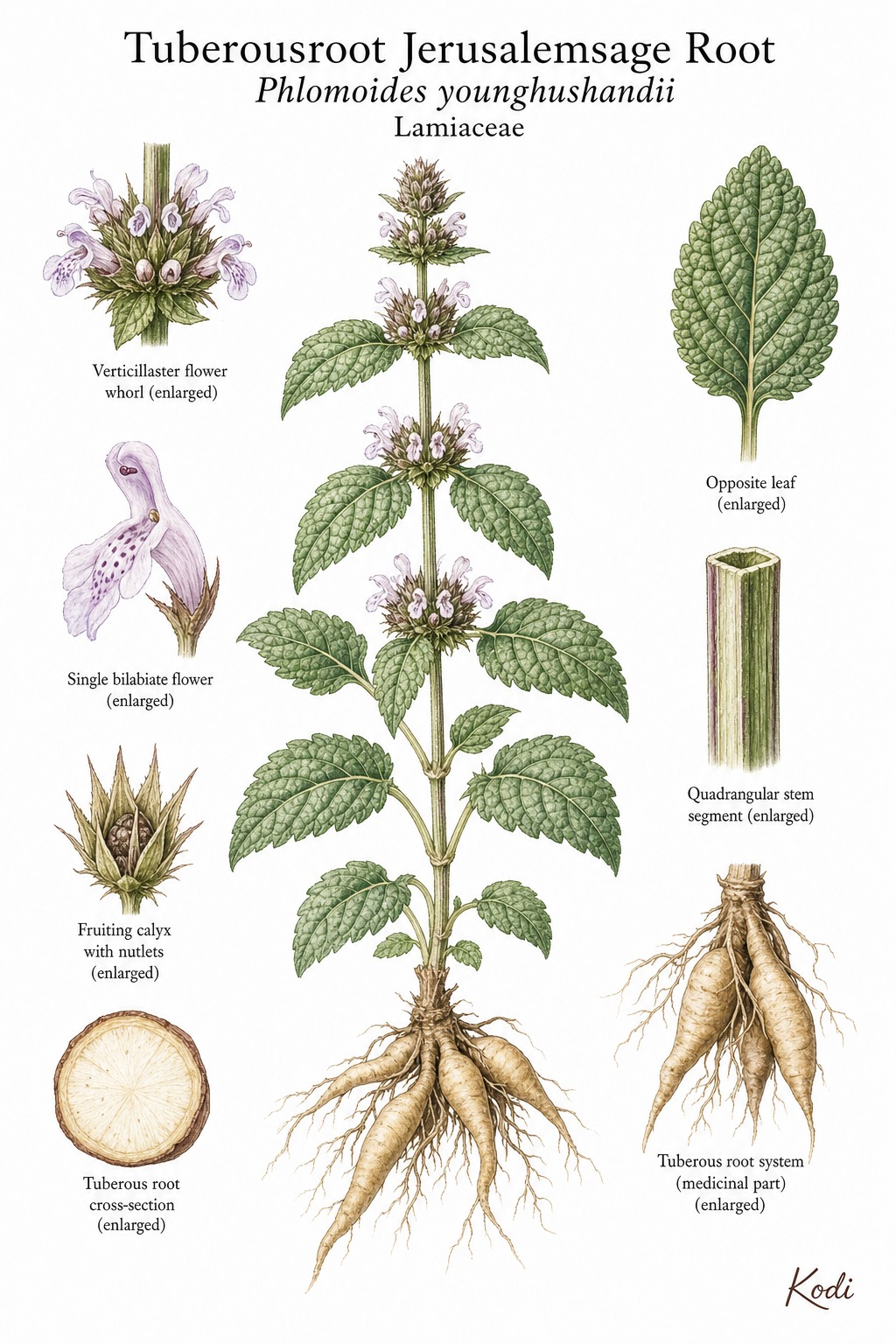
Known in TCM as Kuai Gen Cao Su (块根糙苏), this bitter and pungent, cool herb enters the Liver, Kidney, and Lung. Traditionally, it dispels Wind-Damp and relieves Bi syndrome, most often applied for rheumatism, joint pain, and cough. Modern research has identified Iridoid glycosides (anti-inflammatory, hepatoprotective among its active constituents.
Part used: Root
Also Known As
Latin: Radix Phlomis Kawaguchii | Pinyin: Kuai Gen Cao Su | Chinese: 块根糙苏
TCM Properties
- Taste
- bitter, pungent
- Temperature
- cool
- Channels
- Liver, Kidney, Lung
Traditional Use
Primary Actions
- Dispels Wind-Damp and relieves Bi syndrome … rheumatic joint and muscle pain, especially in the lower body
- Clears Heat and resolves toxicity … febrile illness, carbuncles, and throat infections
- Stops cough and transforms Phlegm … Lung-heat cough with phlegm
- Cools Blood … skin eruptions and bleeding from Blood Heat
Secondary Actions
- Anti-inflammatory … used in Japanese and Chinese folk medicine for swollen, painful joints and muscle aches
- External use: decoction wash for skin sores and inflammatory skin conditions in east Asia folk practice
Classical References
- IMPORT NOTE: XLSX source filed this herb as 'All-Grass Or Root' but the Latin (Radix Phlomis Kawaguchii) specifies the root as the official drug part; Phlomis kawaguchii Ohwi (块根糙苏; Lamiaceae) is a tuberous-rooted Jerusalem Sage species native to Japan and eastern China; less commonly documented in classical Chinese materia medica than the related Phlomis umbrosa (糙苏, Cao Su); folk use is documented in regional east China and Japanese traditional medicine
- Zhong Guo Zhong Yao Zi Yuan Zhi (中国中药资源志): records Kuai Gen Cao Su (块根糙苏) as a regional folk herb used in east China coastal provinces for Wind-Damp bi syndrome, throat infection, and cough; the tuberous root is used both internally and externally
Modern Research
Active Compounds
- Iridoid glycosides (anti-inflammatory, hepatoprotective … characteristic of Lamiaceae Phlomis genus)
- Phlinoside A and B (phenylethanoid glycosides; antioxidant, anti-inflammatory … characteristic of Phlomis spp.)
- Rosmarinic acid (phenylpropanoid ester; anti-inflammatory, antioxidant)
- Luteolin and apigenin (flavonoids; anti-inflammatory)
- Ursolic acid and oleanolic acid (triterpenoids; anti-inflammatory, antimicrobial)
Studied Effects
- Anti-inflammatory: phenylethanoid glycosides and iridoid fractions from Phlomis species inhibit NF-κB and reduce prostaglandin E2 synthesis in LPS-stimulated macrophage models; in vivo anti-inflammatory activity confirmed in paw-edema assays; rosmarinic acid contributes antioxidant cytoprotection … provides mechanistic basis for the Wind-Damp and Heat-toxin resolving folk applications
- Antimicrobial: essential oil and flavonoid fractions from Phlomis species show inhibitory activity against Staphylococcus aureus, Streptococcus pyogenes, and skin pathogens … consistent with the folk use for throat infections and skin sores
- Antioxidant: total phenolic content from P. kawaguchii root demonstrates significant DPPH radical scavenging activity; triterpenoids (ursolic acid, oleanolic acid) provide additional cytoprotective antioxidant effects
Safety & Interactions
Contraindications
- Spleen-Stomach Deficiency Cold … cool-bitter nature impairs digestive Yang with prolonged use
- Cold-Damp Bi syndrome without Heat signs … cool nature contraindicated in purely cold arthritic patterns
Cautions
- Standard dose: 9–15 g dried root in decoction; external: decoction wash as needed
- Limited formal clinical safety and pharmacokinetic data; considered safe at traditional doses based on regional folk use
- Pregnancy: cool-bitter herb; traditional caution advised
Conditions
- Rheumatism Traditional ★★★☆☆ JSON
- Joint Pain Traditional ★★★☆☆ JSON
- Cough Traditional ★★☆☆☆ JSON
- Tonsillitis Traditional ★★☆☆☆ JSON
Frequently Asked Questions
What is Tuberousroot Jerusalemsage Root used for?
Tuberousroot Jerusalemsage Root is traditionally used to Dispels Wind-Damp and relieves Bi syndrome … rheumatic joint and muscle pain, especially in the lower body, Clears Heat and resolves toxicity … febrile illness, carbuncles, and throat infections, Stops cough and transforms Phlegm … Lung-heat cough with phlegm, Cools Blood … skin eruptions and bleeding from Blood Heat. Research has investigated its effects on: Anti-inflammatory: phenylethanoid glycosides and iridoid fractions from Phlomis species inhibit NF-κB and reduce prostaglandin E2 synthesis in LPS-stimulated macrophage models; in vivo anti-inflammatory activity confirmed in paw-edema assays; rosmarinic acid contributes antioxidant cytoprotection … provides mechanistic basis for the Wind-Damp and Heat-toxin resolving folk applications; Antimicrobial: essential oil and flavonoid fractions from Phlomis species show inhibitory activity against Staphylococcus aureus, Streptococcus pyogenes, and skin pathogens … consistent with the folk use for throat infections and skin sores.
What are other names for Tuberousroot Jerusalemsage Root?
Tuberousroot Jerusalemsage Root is also known as Phlomis. In TCM: 块根糙苏 (Kuai Gen Cao Su); Radix Phlomis Kawaguchii.
Is Tuberousroot Jerusalemsage Root safe during pregnancy?
The safety of Tuberousroot Jerusalemsage Root during pregnancy has not been established. Consult a qualified healthcare provider before use.
What are the contraindications for Tuberousroot Jerusalemsage Root?
Tuberousroot Jerusalemsage Root should not be used in: Spleen-Stomach Deficiency Cold … cool-bitter nature impairs digestive Yang with prolonged use; Cold-Damp Bi syndrome without Heat signs … cool nature contraindicated in purely cold arthritic patterns. Consult a qualified healthcare provider before use.