Eclipta Herb
- Chinese
- 墨旱莲
- Pinyin
- Mo Han Lian
- Latin
- Herba Ecliptae
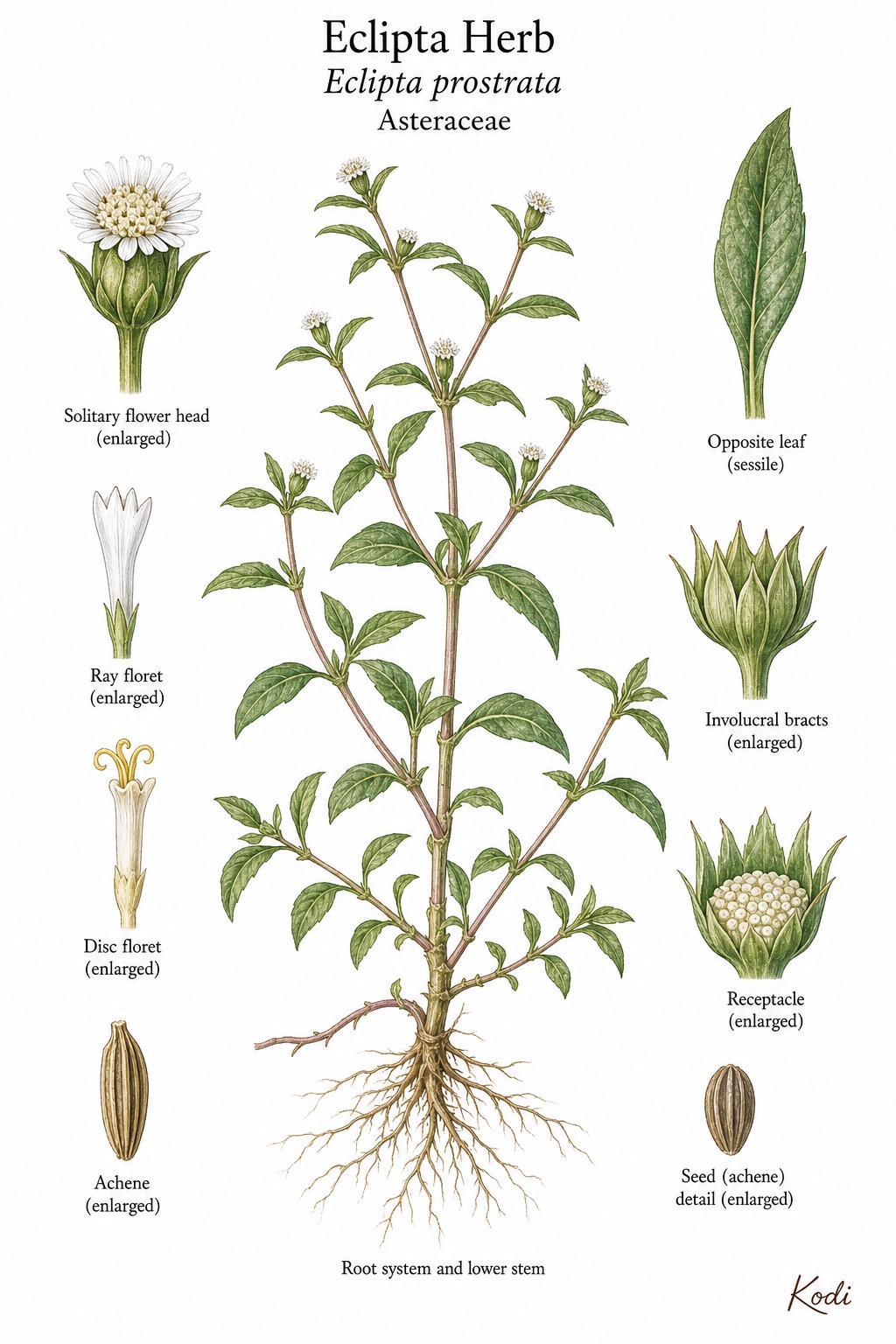
Known in TCM as Mo Han Lian (墨旱莲), this sweet and sour, cold herb enters the Liver and Kidney. Traditionally, it nourishes Liver and Kidney Yin, most often applied for hair loss, hematuria, and uterine bleeding. Modern research has identified Wedelolactone among its active constituents.
Part used: Whole herb
Also Known As
Latin: Herba Ecliptae | Pinyin: Mo Han Lian | Chinese: 墨旱莲
TCM Properties
- Taste
- sweet, sour
- Temperature
- cold
- Channels
- Liver, Kidney
Traditional Use
Primary Actions
- Nourishes Liver and Kidney Yin … dizziness, tinnitus, blurred vision, premature graying of hair, and sore lower back from Liver-Kidney Yin deficiency
- Cools Blood and stops bleeding … hemoptysis, hematuria, epistaxis, hematochezia, and uterine bleeding from Blood Heat or Yin deficiency with Heat
- Promotes hair growth and prevents premature graying … applied fresh or as a topical preparation for hair loss, alopecia, and early graying
Secondary Actions
- Hepatoprotective tonic … used in modern TCM for chronic hepatitis and liver injury with Liver-Kidney Yin deficiency pattern; reduces transaminase elevation
- Global hair care use … used as 'bhringraj' oil in Ayurveda and 'yerbadetajo' in Latin America for identical hair-growth and scalp conditions; one of the few TCM herbs with confirmed global traditional parallel use
Classic Formulas
- Er Zhi Wan (二至丸) … the quintessential formula for Liver-Kidney Yin deficiency; Mo Han Lian combined with Nü Zhen Zi (女贞子, Ligustrum lucidum fruit); the formula name means 'Two-Solstice Pill' because Mo Han Lian is harvested at the summer solstice and Nü Zhen Zi at the winter solstice; simple, elegant, effective; widely used for age-related dizziness, tinnitus, hair greying, and menopausal syndrome
- Commonly combined with Sheng Di Huang (生地黄), E Jiao (阿胶), and Bai Ji (白及) in formulas for Blood-Heat bleeding with Yin deficiency
Classical References
- Ben Cao Gang Mu (Li Shizhen): 'Mo Han Lian (ink-dry lotus, named because the fresh plant juice oxidises black when exposed to air) benefits the kidney and liver, makes the teeth firm, cools blood, stops bleeding, and blackens hair and beard … a superior herb for those who are prematurely grey or suffer from lower-back weakness'
- ENGLISH NAME NOTE: 'Yerbadetajo' is the Spanish folk name (from Latin American traditional medicine) for Eclipta prostrata … meaning 'herb of the cut' for its haemostatic use; the slug reflects this international common name; the official TCM name is Mo Han Lian (墨旱莲) and the Ayurvedic name is Bhringraj
Modern Research
Active Compounds
- Wedelolactone (coumestan; principal bioactive; hepatoprotective, estrogenic, anti-inflammatory, 5-alpha-reductase inhibition relevant to hair growth)
- Eclalbasaponin I and II (triterpenoid saponins; anti-inflammatory, hepatoprotective)
- Luteolin and apigenin glycosides (flavonoids; anti-inflammatory, antioxidant)
- Phytol (diterpene alcohol; antioxidant, immunostimulatory)
- Ecliptine (alkaloid; anti-inflammatory)
- Beta-amyrin and oleanolic acid (triterpenoids; hepatoprotective, anti-inflammatory)
Studied Effects
- Hepatoprotective: wedelolactone and eclalbasaponins from Eclipta prostrata protect hepatocytes against CCl4, paracetamol, and alcohol-induced injury; mechanisms include antioxidant free-radical scavenging, NF-κB inhibition, and CYP2E1 suppression; clinical studies from India and China confirm transaminase reduction in chronic hepatitis patients … validates the modern hepatitis and liver tonic applications within the Liver-Kidney Yin nourishing framework
- Haemostatic: ethanolic extract of E. prostrata reduces tail-transection bleeding time and increases platelet count in rodent models; wedelolactone activates coagulation pathways while simultaneously reducing oxidative damage to vascular endothelium … mechanistic basis for the classical cooling-blood and stopping-bleeding indications across multiple bleeding sites
- Hair growth promotion: wedelolactone inhibits 5-alpha-reductase (the enzyme converting testosterone to DHT), the same target as the pharmaceutical finasteride; topical Eclipta preparations promote anagen phase hair follicle proliferation in animal models … validates the classical hair-growth and anti-greying application across TCM, Ayurveda, and Latin American traditional medicine
Safety & Interactions
Contraindications
- Spleen-Stomach Deficiency Cold … cold-sour nature impairs digestive Yang; avoid with chronic diarrhea, cold abdomen, and weak digestion
- Cold-type bleeding without Blood Heat or Yin deficiency … cooling haemostatic inappropriate for cold deficiency haemorrhage
Cautions
- Standard dose: 6–12 g dried herb in decoction; 30–60 g fresh herb; topical: fresh juice or oil preparation for scalp
- Wedelolactone has weak estrogenic activity … exercise caution in hormone-sensitive conditions (estrogen-dependent breast cancer, uterine fibroids, endometriosis) at high sustained doses; not clinically significant at standard therapeutic doses
- 5-Alpha-reductase inhibition: theoretical additive effect with finasteride and dutasteride for hair loss treatment; no adverse interaction expected but combination not formally studied
- Generally considered safe at therapeutic doses with centuries of culinary and medicinal use worldwide
Conditions
Frequently Asked Questions
What is Eclipta Herb used for?
Eclipta Herb is traditionally used to Nourishes Liver and Kidney Yin … dizziness, tinnitus, blurred vision, premature graying of hair, and sore lower back from Liver-Kidney Yin deficiency, Cools Blood and stops bleeding … hemoptysis, hematuria, epistaxis, hematochezia, and uterine bleeding from Blood Heat or Yin deficiency with Heat, Promotes hair growth and prevents premature graying … applied fresh or as a topical preparation for hair loss, alopecia, and early graying. Research has investigated its effects on: Hepatoprotective: wedelolactone and eclalbasaponins from Eclipta prostrata protect hepatocytes against CCl4, paracetamol, and alcohol-induced injury; mechanisms include antioxidant free-radical scavenging, NF-κB inhibition, and CYP2E1 suppression; clinical studies from India and China confirm transaminase reduction in chronic hepatitis patients … validates the modern hepatitis and liver tonic applications within the Liver-Kidney Yin nourishing framework; Haemostatic: ethanolic extract of E. prostrata reduces tail-transection bleeding time and increases platelet count in rodent models; wedelolactone activates coagulation pathways while simultaneously reducing oxidative damage to vascular endothelium … mechanistic basis for the classical cooling-blood and stopping-bleeding indications across multiple bleeding sites.
What are other names for Eclipta Herb?
Eclipta Herb is also known as Eclipta. In TCM: 墨旱莲 (Mo Han Lian); Herba Ecliptae.
Is Eclipta Herb safe during pregnancy?
The safety of Eclipta Herb during pregnancy has not been established. Consult a qualified healthcare provider before use.
What are the contraindications for Eclipta Herb?
Eclipta Herb should not be used in: Spleen-Stomach Deficiency Cold … cold-sour nature impairs digestive Yang; avoid with chronic diarrhea, cold abdomen, and weak digestion; Cold-type bleeding without Blood Heat or Yin deficiency … cooling haemostatic inappropriate for cold deficiency haemorrhage. Consult a qualified healthcare provider before use.