Impatiens-type Penetrate-Bone Herb
- Chinese
- 凤仙透骨草
- Pinyin
- Feng Xian Tou Gu Cao
- Latin
- Herba Speranskiae Tuberculatae
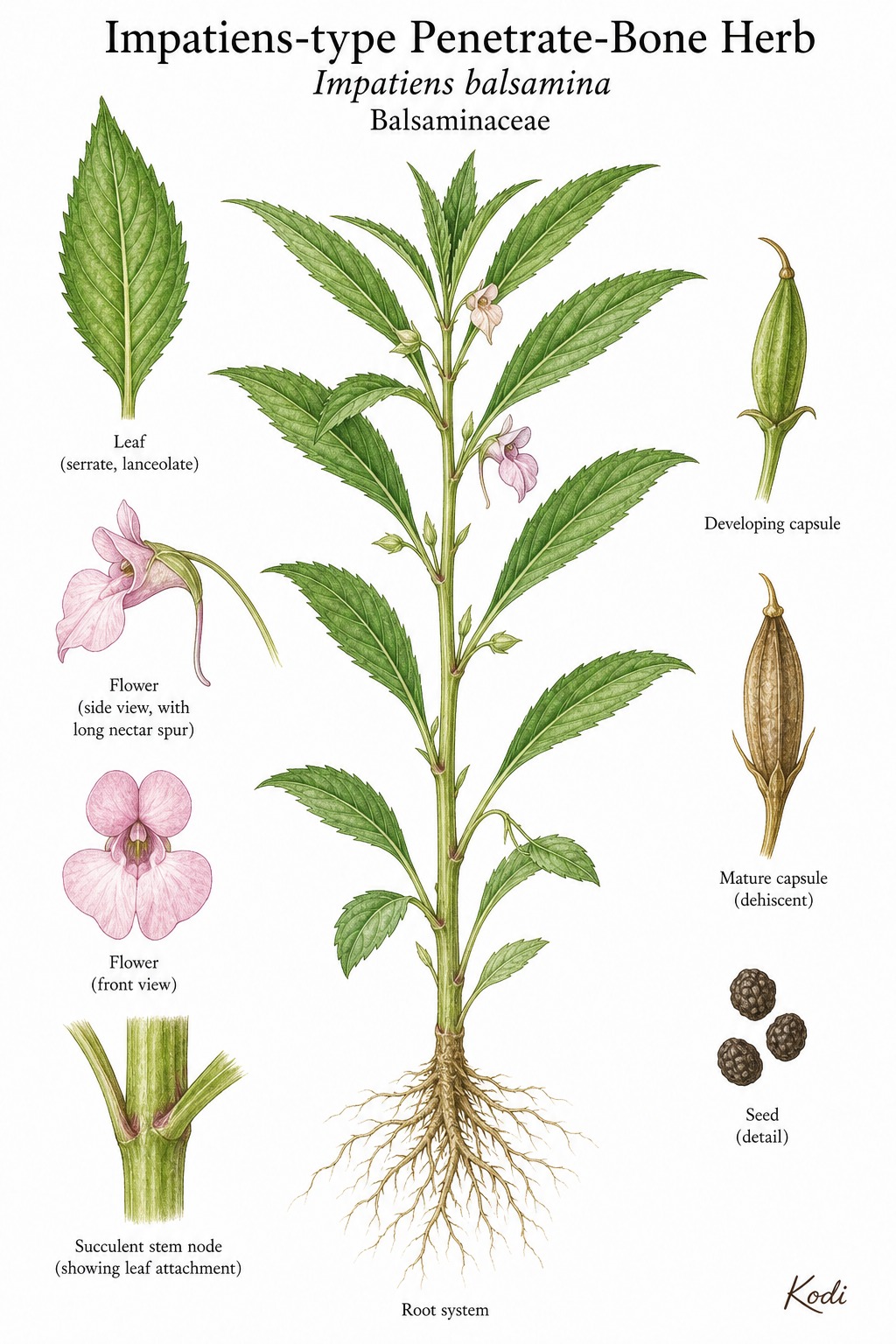
Known in TCM as Feng Xian Tou Gu Cao (凤仙透骨草), this pungent, warm herb enters the Liver and Kidney. Traditionally, it dispels Wind-Damp and relieves Bi syndrome, most often applied for rheumatoid arthritis, rheumatism, and joint pain. Modern research has identified 2-Methoxy-1,4-naphthoquinone among its active constituents.
Part used: Whole herb
Also Known As
Latin: Herba Speranskiae Tuberculatae | Pinyin: Feng Xian Tou Gu Cao | Chinese: 凤仙透骨草
TCM Properties
- Taste
- pungent
- Temperature
- warm
- Channels
- Liver, Kidney
Traditional Use
Primary Actions
- Dispels Wind-Damp and relieves Bi syndrome … rheumatic joint and muscle pain, especially cold-damp type with stiffness and heaviness
- Warms channels and disperses Cold … cold-obstructed pain in the joints, lumbar region, and extremities
- Relaxes sinews and relieves spasm … muscle cramps and sinew contracture from Cold-Damp obstruction
- External use for joint pain and injuries … decoction wash or poultice for arthritic swelling and traumatic injuries
Secondary Actions
- Promotes menstruation … mild Blood-moving action; used in north China folk medicine for amenorrhea with Cold pattern
- Folk antimicrobial … topical decoction wash for fungal nail infections and tinea pedis in traditional east China practice
Classic Formulas
- Tou Gu Cao Wan or decoction formulations … combined with Wei Ling Xian (威灵仙), Du Huo (独活), Fang Feng (防风), and Gui Zhi (桂枝) for Wind-Cold-Damp Bi syndrome with cold-predominant joint pain; used as the Tou Gu Cao drug in regional formulas where the Impatiens-derived variant is the available source
Classical References
- SPECIES DISAMBIGUATION: The pinyin 'Feng Xian Tou Gu Cao' (凤仙透骨草) indicates the Impatiens-derived variant of Tou Gu Cao … 'Feng Xian' (凤仙) is Impatiens balsamina L. (garden balsam/touch-me-not; Balsaminaceae), used as a regional source of Tou Gu Cao in northern and eastern China; the XLSX source assigns the official Latin Herba Speranskiae Tuberculatae (which strictly refers to Speranskia tuberculata) to both this herb (#84) and the primary Tou Gu Cao drug (#85) … the two plants share the TCM indication for Wind-Damp Bi syndrome but differ in botanical source; Impatiens balsamina is also the source of Ji Xing Zi (急性子, seeds) and Feng Xian Hua (凤仙花, flowers), two separate TCM drugs
- Shan Dong Zhong Cao Yao Shou Ce (山东中草药手册): documents Feng Xian Tou Gu Cao specifically as the Impatiens balsamina-derived penetrate-bone herb used in Shandong folk medicine for rheumatic pain, arthritic joints, and menstrual irregularities
Modern Research
Active Compounds
- 2-Methoxy-1,4-naphthoquinone (lawsone precursor; from Impatiens species; anti-inflammatory, antifungal)
- Kaempferol and quercetin glycosides (flavonoids; anti-inflammatory, antioxidant)
- Balsaminol A and B (sesquiterpene alcohols; anti-inflammatory)
- Phenolic acids: p-coumaric acid, ferulic acid (antioxidant, anti-inflammatory)
- Sterols: β-sitosterol, stigmasterol
Studied Effects
- Anti-inflammatory and analgesic: flavonoid and naphthoquinone fractions from Impatiens balsamina inhibit COX-2 and prostaglandin E2 synthesis in inflammatory cell models; hot-plate and acetic-acid writhing tests in rodents confirm central and peripheral analgesic activity … validates the Wind-Damp pain-relieving indication
- Antifungal: 2-methoxy-1,4-naphthoquinone from I. balsamina shows strong antifungal activity against Candida albicans, Trichophyton rubrum, and Microsporum canis in MIC assays … provides mechanistic basis for the traditional folk use as a topical soak for fungal nail infections and tinea
- Anti-arthritic: aqueous and ethanol extracts of I. balsamina reduce paw swelling and pro-inflammatory cytokine levels in adjuvant-induced arthritis models; mechanism involves NF-κB pathway inhibition … supports the Bi-syndrome application for rheumatic joint disease
Safety & Interactions
Contraindications
- Heat-type Bi syndrome (hot, red, swollen joints with fever) … warm-pungent nature contraindicated
- Pregnancy: Blood-moving action; traditional caution; high doses avoided
Cautions
- Standard dose: 9–15 g dried herb in decoction; commonly used as a decoction wash (30–60 g) for external joint and skin applications
- Topical use: concentrated decoction may cause mild skin irritation in sensitive individuals; patch test before extended topical use
- No significant systemic drug interactions identified at standard therapeutic doses
Conditions
- Rheumatoid Arthritis Traditional ★★★☆☆ JSON
- Rheumatism Traditional ★★★★☆ JSON
- Joint Pain Traditional ★★★★☆ JSON
Frequently Asked Questions
What is Impatiens-type Penetrate-Bone Herb used for?
Impatiens-type Penetrate-Bone Herb is traditionally used to Dispels Wind-Damp and relieves Bi syndrome … rheumatic joint and muscle pain, especially cold-damp type with stiffness and heaviness, Warms channels and disperses Cold … cold-obstructed pain in the joints, lumbar region, and extremities, Relaxes sinews and relieves spasm … muscle cramps and sinew contracture from Cold-Damp obstruction, External use for joint pain and injuries … decoction wash or poultice for arthritic swelling and traumatic injuries. Research has investigated its effects on: Anti-inflammatory and analgesic: flavonoid and naphthoquinone fractions from Impatiens balsamina inhibit COX-2 and prostaglandin E2 synthesis in inflammatory cell models; hot-plate and acetic-acid writhing tests in rodents confirm central and peripheral analgesic activity … validates the Wind-Damp pain-relieving indication; Antifungal: 2-methoxy-1,4-naphthoquinone from I. balsamina shows strong antifungal activity against Candida albicans, Trichophyton rubrum, and Microsporum canis in MIC assays … provides mechanistic basis for the traditional folk use as a topical soak for fungal nail infections and tinea.
What are other names for Impatiens-type Penetrate-Bone Herb?
Impatiens-type Penetrate-Bone Herb is also known as Speranskia. In TCM: 凤仙透骨草 (Feng Xian Tou Gu Cao); Herba Speranskiae Tuberculatae.
Is Impatiens-type Penetrate-Bone Herb safe during pregnancy?
Impatiens-type Penetrate-Bone Herb is not recommended during pregnancy.
What are the contraindications for Impatiens-type Penetrate-Bone Herb?
Impatiens-type Penetrate-Bone Herb should not be used in: Heat-type Bi syndrome (hot, red, swollen joints with fever) … warm-pungent nature contraindicated; Pregnancy: Blood-moving action; traditional caution; high doses avoided. Consult a qualified healthcare provider before use.