Tokyo Violet Herb
- Chinese
- 地丁
- Pinyin
- Di Ding
- Latin
- Herba Violae Seu Gueldenstaedtiae
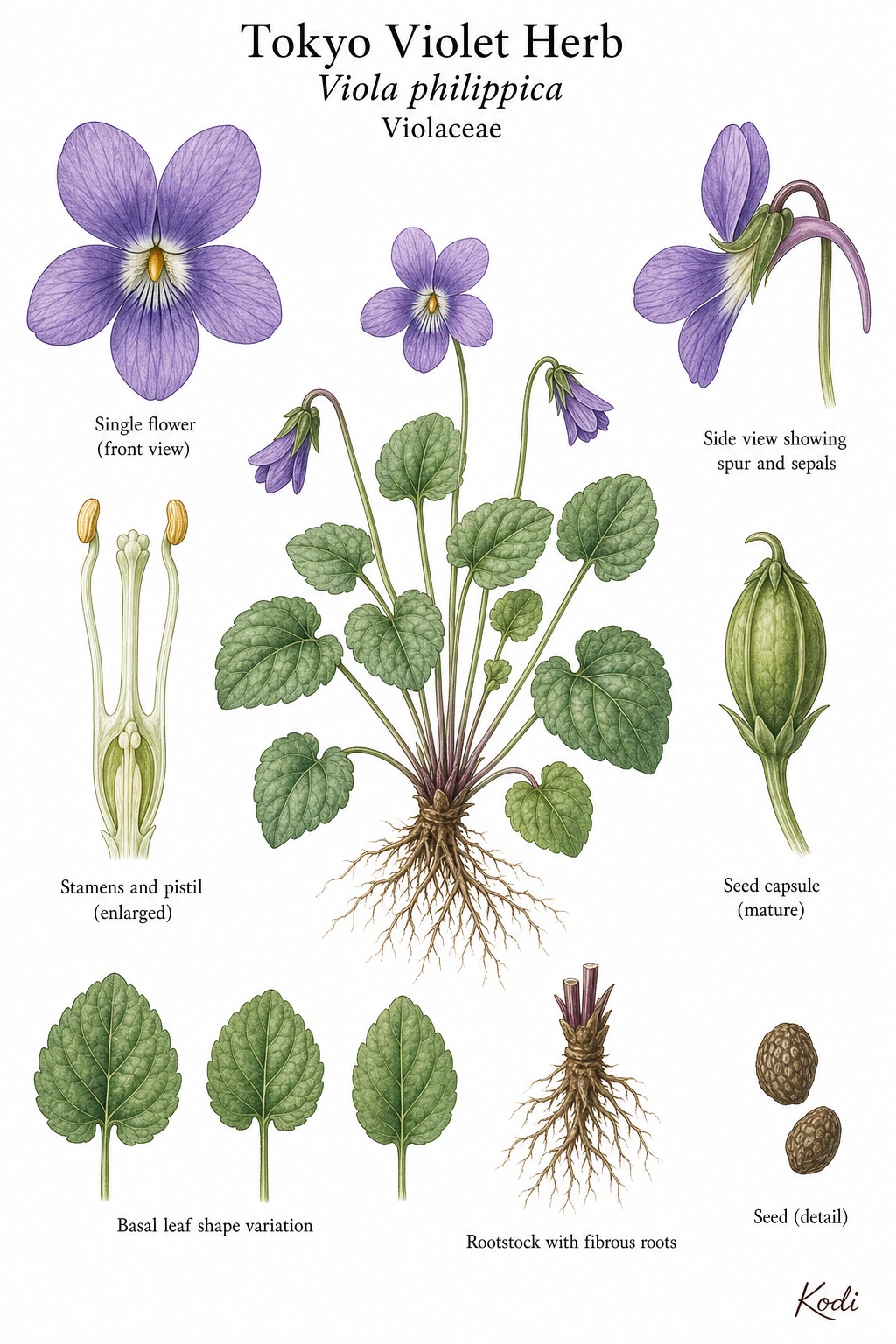
Known in TCM as Di Ding (地丁), this bitter and pungent, cold herb enters the Liver and Heart. Traditionally, it clears Heat and resolves fire toxin, most often applied for carbuncle, tonsillitis, and conjunctivitis. Modern research has identified Violacin among its active constituents.
Part used: Whole herb
Also Known As
Latin: Herba Violae Seu Gueldenstaedtiae | Pinyin: Di Ding | Chinese: 地丁
TCM Properties
- Taste
- bitter, pungent
- Temperature
- cold
- Channels
- Liver, Heart
Traditional Use
Primary Actions
- Clears Heat and resolves fire toxin … carbuncles, abscesses, furuncles, deep-rooted sores, and venomous snake or insect bite; one of the premier fire-toxin herbs in TCM
- Reduces swelling and disperses nodules … lymph node swellings, breast abscess, and scrofula from hot-toxin accumulation
- Anti-inflammatory for the throat and eyes … tonsillitis, pharyngitis, acute conjunctivitis, and orbital cellulitis
- Cools Blood and clears skin conditions … skin eruptions, urticaria, and furuncles from Blood Heat
Secondary Actions
- External application … fresh herb pounded into a poultice; one of the most widely applied topical emergency herbs for carbuncles, snake bite, and infected wounds throughout China
- Antiviral folk use … used in conjunction with other Heat-clearing herbs for epidemic febrile illness and viral hepatitis in south China folk tradition
Classic Formulas
- Wu Wei Xiao Du Yin (五味消毒饮) … classical formula for fire-toxin patterns; Di Ding combined with Jin Yin Hua (金银花), Pu Gong Ying (蒲公英), Zi Bei Tian Kui Zi (紫背天葵子), and Ye Ju Hua (野菊花) … one of the most important and widely used formulas for acute infections, carbuncles, tonsillitis, and furuncles; from Yi Zong Jin Jian (1742)
- External poultice: fresh Di Ding herb pounded with garlic and applied to carbuncles and snake bite as emergency first aid … classical folk application documented in multiple regional materia medica
Classical References
- Ben Cao Gang Mu (Li Shizhen): 'Di Ding (地丁, earth nail) resolves fire toxin, disperses swellings, and draws out poisons from deep sores … applied fresh externally and taken as decoction internally; very effective for carbuncle with intense heat and deep root'
- SPECIES NOTE: The Latin Herba Violae Seu Gueldenstaedtiae acknowledges two distinct plants used interchangeably as Di Ding … Viola yedoensis Makino (紫花地丁, Zi Hua Di Ding; Violaceae; the official Chinese Pharmacopoeia 2020 species) and Gueldenstaedtia multiflora Bunge (甜地丁, Tian Di Ding; Leguminosae; used in northern China as a regional substitute); both share the bitter-cold heat-toxin-resolving profile though Viola yedoensis is considered the primary source
Modern Research
Active Compounds
- Violacin and related benzoxazinoid alkaloids (antimicrobial, cytotoxic)
- Rutin, quercetin, and luteolin (flavonoids; anti-inflammatory, antioxidant, antiviral)
- Saponins (antimicrobial, anti-inflammatory, immunostimulatory)
- Mucilage (demulcent, wound-soothing)
- Tannins (astringent, antimicrobial, antiviral)
- Caffeic acid and chlorogenic acid (phenolic acids; antioxidant, antimicrobial)
Studied Effects
- Anti-inflammatory: aqueous and ethanol extracts of Viola yedoensis significantly inhibit COX-2, NF-κB, and TNF-α/IL-6 production in LPS-stimulated macrophage models; in vivo anti-inflammatory efficacy demonstrated in carrageenan paw edema and cotton pellet granuloma assays … validates the fire-toxin and carbuncle indications in both acute and chronic inflammatory contexts
- Antimicrobial: flavonoid and saponin fractions from V. yedoensis inhibit Staphylococcus aureus (including MRSA strains), Streptococcus pyogenes, and Pseudomonas aeruginosa; the broad antimicrobial spectrum is consistent with the traditional use for purulent infections, tonsillitis, and snake bite wound management
- Anticancer: quercetin, luteolin, and crude alkaloid fractions from Di Ding preparations induce apoptosis in hepatocellular carcinoma, lung cancer, and cervical cancer cell lines via caspase-3 activation and Bcl-2 downregulation … provides mechanistic support for its inclusion in modern TCM integrative oncology protocols alongside Bai Hua She She Cao
Safety & Interactions
Contraindications
- Yin-type sores (cold, pale, non-inflamed, non-erythematous lesions) … cold-bitter nature contraindicated in cold-deficiency abscesses
- Spleen-Stomach Deficiency Cold … cold-bitter herb will damage digestive Yang with prolonged use
Cautions
- Standard dose: 15–30 g dried herb in decoction; 30–60 g fresh herb; topical: fresh herb pounded as poultice
- Generally considered safe at therapeutic doses; no significant systemic toxicity documented in traditional use or animal studies
- Immunosuppressants: saponin-mediated immunostimulation … theoretical antagonism; monitor transplant patients on immunosuppressive therapy
- Pregnancy: cold-bitter nature traditionally used cautiously; short-term use at standard doses generally considered acceptable for acute infections; avoid prolonged high-dose use
Conditions
- Carbuncle Traditional ★★★★★ JSON
- Tonsillitis Traditional ★★★★☆ JSON
- Conjunctivitis Traditional ★★★☆☆ JSON
- Cancer Research ★★☆☆☆ JSON
- Eczema Traditional ★★★☆☆ JSON
Frequently Asked Questions
What is Tokyo Violet Herb used for?
Tokyo Violet Herb is traditionally used to Clears Heat and resolves fire toxin … carbuncles, abscesses, furuncles, deep-rooted sores, and venomous snake or insect bite; one of the premier fire-toxin herbs in TCM, Reduces swelling and disperses nodules … lymph node swellings, breast abscess, and scrofula from hot-toxin accumulation, Anti-inflammatory for the throat and eyes … tonsillitis, pharyngitis, acute conjunctivitis, and orbital cellulitis, Cools Blood and clears skin conditions … skin eruptions, urticaria, and furuncles from Blood Heat. Research has investigated its effects on: Anti-inflammatory: aqueous and ethanol extracts of Viola yedoensis significantly inhibit COX-2, NF-κB, and TNF-α/IL-6 production in LPS-stimulated macrophage models; in vivo anti-inflammatory efficacy demonstrated in carrageenan paw edema and cotton pellet granuloma assays … validates the fire-toxin and carbuncle indications in both acute and chronic inflammatory contexts; Antimicrobial: flavonoid and saponin fractions from V. yedoensis inhibit Staphylococcus aureus (including MRSA strains), Streptococcus pyogenes, and Pseudomonas aeruginosa; the broad antimicrobial spectrum is consistent with the traditional use for purulent infections, tonsillitis, and snake bite wound management.
What are other names for Tokyo Violet Herb?
Tokyo Violet Herb is also known as Viola. In TCM: 地丁 (Di Ding); Herba Violae Seu Gueldenstaedtiae.
Is Tokyo Violet Herb safe during pregnancy?
The safety of Tokyo Violet Herb during pregnancy has not been established. Consult a qualified healthcare provider before use.
What are the contraindications for Tokyo Violet Herb?
Tokyo Violet Herb should not be used in: Yin-type sores (cold, pale, non-inflamed, non-erythematous lesions) … cold-bitter nature contraindicated in cold-deficiency abscesses; Spleen-Stomach Deficiency Cold … cold-bitter herb will damage digestive Yang with prolonged use. Consult a qualified healthcare provider before use.