Tangut Dragonhead Herb
- Chinese
- 甘青青兰
- Pinyin
- Gan Qing Qing Lan
- Latin
- Herba Dracocephali Tangutici
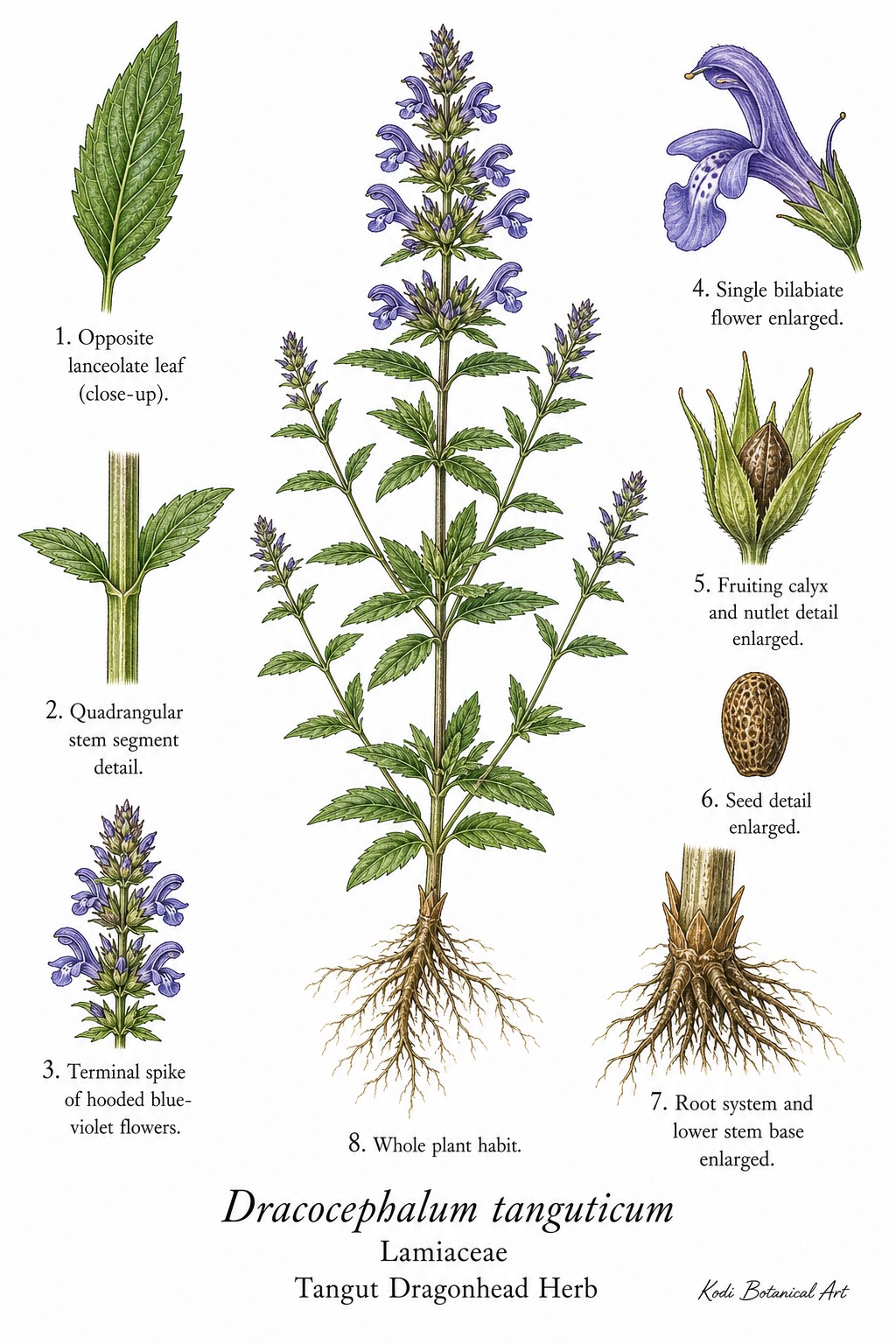
Known in TCM as Gan Qing Qing Lan (甘青青兰), this bitter and pungent, cool herb enters the Liver, Gallbladder, and Lung. Traditionally, it clears Liver and Gallbladder Heat, most often applied for jaundice, cholecystitis, and hepatitis. Modern research has identified Luteolin, among its active constituents.
Part used: Whole herb
Also Known As
Latin: Herba Dracocephali Tangutici | Pinyin: Gan Qing Qing Lan | Chinese: 甘青青兰
TCM Properties
- Taste
- bitter, pungent
- Temperature
- cool
- Channels
- Liver, Gallbladder, Lung
Traditional Use
Primary Actions
- Clears Liver and Gallbladder Heat … jaundice, cholecystitis, hepatitis, and Damp-Heat accumulation in the Liver-Gallbladder axis
- Clears Heat and resolves toxicity … febrile illness, high fever, and hot toxic swellings
- Dispels Wind-Heat and releases the exterior … common cold with fever, headache, and throat pain
- Moves Blood and stops pain … Liver-Qi stagnation with Blood stasis causing hypochondriac pain and gallbladder distension
Secondary Actions
- Tibetan plateau folk use for respiratory conditions … cough and Lung heat patterns in highland alpine medicine traditions of Qinghai and Gansu
- Antispasmodic … used in traditional northwest China folk medicine for smooth muscle spasm in the biliary and gastrointestinal tract
Classical References
- Qinghai Zhong Cao Yao (青海中草药; Qinghai Medicinal Herbs): documents Gan Qing Qing Lan (甘青青兰, 'Gansu-Qinghai Dracocephalum') as a principal Liver-Gallbladder Heat-clearing herb of northwest China and Tibetan plateau folk medicine; used for jaundice, cholecystitis, hepatitis, and febrile illness; endemic to the high-altitude grasslands and rocky slopes of Qinghai, Gansu, and northwest Sichuan
- Si Bu Yi Dian (Tibetan medical canon): Dracocephalum species are used in Sowa-Rigpa medicine for liver and gallbladder inflammatory conditions, fevers, and bile disorders; the 'tangut' designation refers to the Tangut ethnopolitical region encompassing the Xixia Kingdom territory (modern Qinghai-Gansu border highlands)
Modern Research
Active Compounds
- Luteolin, apigenin, and acacetin (flavonoids; anti-inflammatory, antioxidant, antispasmodic)
- Scutellarein and scutellarin (flavone glucuronides; anti-inflammatory, hepatoprotective … characteristic of Lamiaceae)
- Rosmarinic acid (phenylpropanoid ester; anti-inflammatory, antioxidant … the principal phenolic acid of aromatic Lamiaceae)
- Essential oil: caryophyllene, linalool, limonene, and monoterpene hydrocarbons (antimicrobial, spasmolytic)
- Caffeic acid and chlorogenic acid (phenolic acids; antioxidant, anti-inflammatory)
Studied Effects
- Anti-inflammatory: rosmarinic acid and scutellarein from Dracocephalum tanguticum inhibit NF-κB and COX-2 in LPS-stimulated macrophage assays and reduce carrageenan-induced paw edema in rodent models; hepatic anti-inflammatory activity was specifically demonstrated in Concanavalin A-induced liver injury models … validates the Liver-Gallbladder Heat-clearing and hepatoprotective folk applications
- Antispasmodic and choleretic: flavonoid fraction from D. tanguticum relaxes isolated biliary smooth muscle and increases bile flow in perfused liver preparations; luteolin and apigenin have well-documented Ca2+-channel blocking spasmolytic activity in intestinal and biliary tissues … consistent with the traditional gallbladder pain and cholecystitis applications
- Antimicrobial: essential oil from D. tanguticum shows inhibitory activity against common respiratory and gastrointestinal pathogens including Staphylococcus aureus, Streptococcus pneumoniae, and Helicobacter pylori in disc-diffusion assays … supports the fever and throat infection folk uses in Tibetan and northwest China medicine
Safety & Interactions
Contraindications
- Spleen-Stomach Deficiency Cold … cool-bitter nature impairs digestive Yang; contraindicated with chronic loose stools and cold abdomen
- Cold-pattern jaundice (cold body, pale stools, no thirst) … cool herb will worsen Yang deficiency jaundice
Cautions
- Standard dose: 6–15 g dried herb in decoction
- Limited formal pharmacokinetic and clinical safety data for this specific species; considered safe at traditional doses based on regional Tibetan and northwest China folk use
- Pregnancy: cool-bitter Lamiaceae herbs traditionally used with caution in pregnancy
Conditions
Frequently Asked Questions
What is Tangut Dragonhead Herb used for?
Tangut Dragonhead Herb is traditionally used to Clears Liver and Gallbladder Heat … jaundice, cholecystitis, hepatitis, and Damp-Heat accumulation in the Liver-Gallbladder axis, Clears Heat and resolves toxicity … febrile illness, high fever, and hot toxic swellings, Dispels Wind-Heat and releases the exterior … common cold with fever, headache, and throat pain, Moves Blood and stops pain … Liver-Qi stagnation with Blood stasis causing hypochondriac pain and gallbladder distension. Research has investigated its effects on: Anti-inflammatory: rosmarinic acid and scutellarein from Dracocephalum tanguticum inhibit NF-κB and COX-2 in LPS-stimulated macrophage assays and reduce carrageenan-induced paw edema in rodent models; hepatic anti-inflammatory activity was specifically demonstrated in Concanavalin A-induced liver injury models … validates the Liver-Gallbladder Heat-clearing and hepatoprotective folk applications; Antispasmodic and choleretic: flavonoid fraction from D. tanguticum relaxes isolated biliary smooth muscle and increases bile flow in perfused liver preparations; luteolin and apigenin have well-documented Ca2+-channel blocking spasmolytic activity in intestinal and biliary tissues … consistent with the traditional gallbladder pain and cholecystitis applications.
What are other names for Tangut Dragonhead Herb?
Tangut Dragonhead Herb is also known as Dracocephali. In TCM: 甘青青兰 (Gan Qing Qing Lan); Herba Dracocephali Tangutici.
Is Tangut Dragonhead Herb safe during pregnancy?
The safety of Tangut Dragonhead Herb during pregnancy has not been established. Consult a qualified healthcare provider before use.
What are the contraindications for Tangut Dragonhead Herb?
Tangut Dragonhead Herb should not be used in: Spleen-Stomach Deficiency Cold … cool-bitter nature impairs digestive Yang; contraindicated with chronic loose stools and cold abdomen; Cold-pattern jaundice (cold body, pale stools, no thirst) … cool herb will worsen Yang deficiency jaundice. Consult a qualified healthcare provider before use.