Sweet Wormwood Herb
- Chinese
- 黄花蒿
- Pinyin
- Huang Hao
- Latin
- Herba Artemisiae Annuae
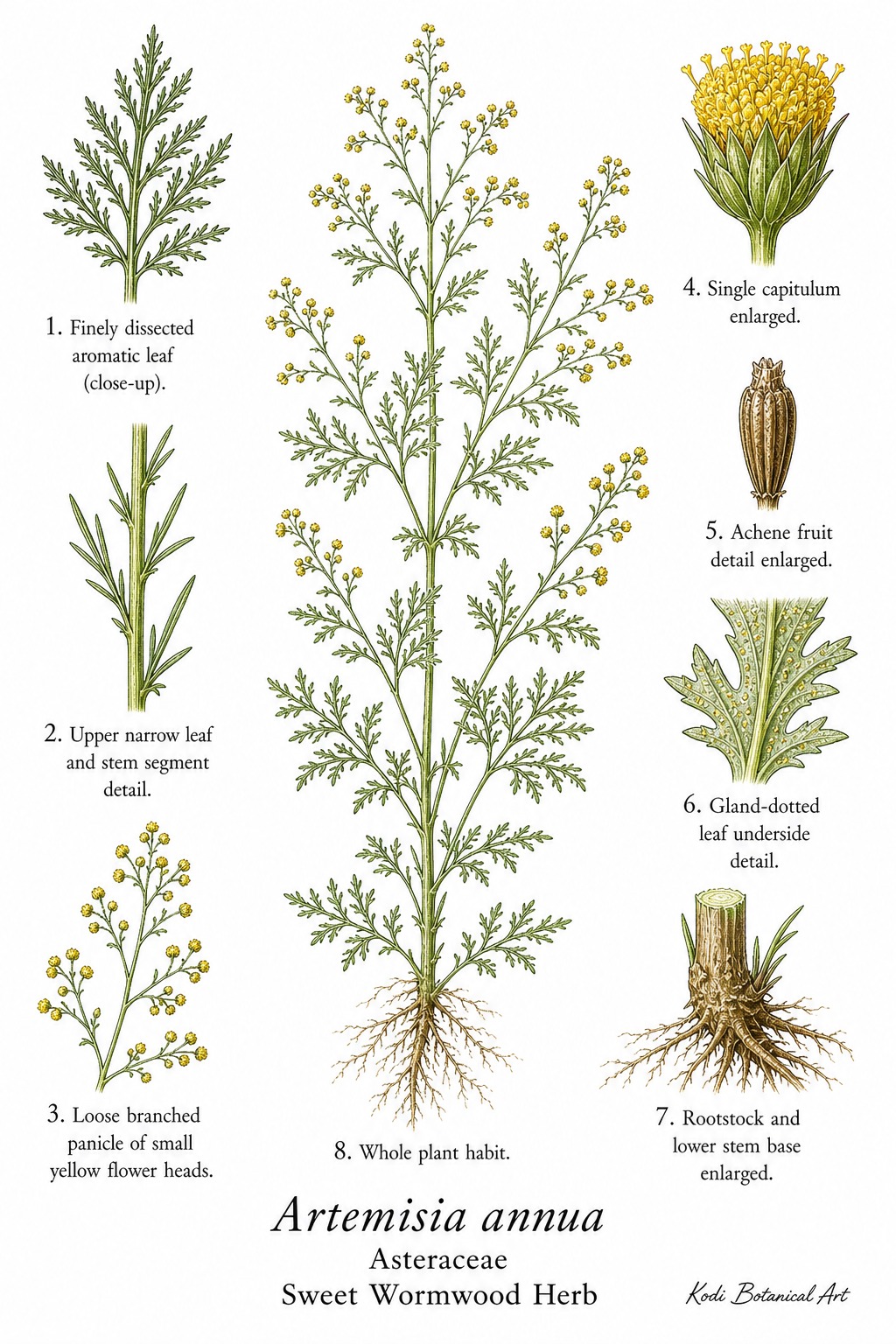
Known in TCM as Huang Hao (黄花蒿), this bitter and pungent, cold herb enters the Liver, Gallbladder, and Kidney. Traditionally, it clears Deficiency Heat and cools bone-steaming fever, most often applied for malaria, fever, and cancer. Modern research has identified Artemisinin among its active constituents.
Part used: Whole herb
Also Known As
Latin: Herba Artemisiae Annuae | Pinyin: Huang Hao | Chinese: 黄花蒿
TCM Properties
- Taste
- bitter, pungent
- Temperature
- cold
- Channels
- Liver, Gallbladder, Kidney
Traditional Use
Primary Actions
- Clears Deficiency Heat and cools bone-steaming fever … tidal fever, night sweats, and steaming-bone sensation from Yin deficiency; principal TCM herb for late-stage febrile disease with lingering Heat in the Ying level
- Clears Summer-Heat and releases exterior … summer febrile illness, alternating fever and chills, and nausea
- Resolves malarial disorder … alternating chills and fever of malaria; the primary source of artemisinin, the modern WHO first-line anti-malarial drug
- Cools the Blood … skin eruptions and bleeding from Blood Heat
Secondary Actions
- Cools Liver Heat … red eyes and headache from Liver Heat uprising
- Aromatic digestive … pungent volatile fraction used in folk medicine for nausea, poor appetite, and summer heat-induced indigestion
Classic Formulas
- Qing Hao Bie Jia Tang (青蒿鳖甲汤) … Wu Jutong's (温病条辨, 1798) classical formula for late-stage Wen Bing with Yin deficiency and residual heat in the Ying level; Qing Hao combined with Bie Jia (soft-shelled turtle shell), Sheng Di Huang, Zhi Mu, and Mu Dan Pi … the definitive formula for 'steaming-bone fever' with night sweats and low-grade persistent fever
- Hao Qin Qing Dan Tang (蒿芩清胆汤) … modern classic for Damp-Heat in the Gallbladder with alternating fever-chills and bitter taste; Qing Hao combined with Huang Qin, Zhi Ban Xia, Chi Fu Ling, Zhu Ru, Bi Yu San
Classical References
- Zhou Hou Bei Ji Fang (肘后备急方, Ge Hong, ~340 CE): 'To treat malaria, take a handful of Qing Hao in two sheng of water, wring out the juice, and drink it all' … this passage, a direct cold-water extraction avoiding heat-labile destruction of artemisinin, was specifically cited by Tu Youyou as the inspiration leading to the discovery of artemisinin; the 2015 Nobel Prize in Physiology or Medicine was awarded to Tu Youyou for this discovery
- NAMING NOTE: The stub pinyin 'Huang Hao' (黄蒿) is a regional dialect name for Artemisia annua; the official Chinese Pharmacopoeia 2020 name is 'Qing Hao' (青蒿), Latin Herba Artemisiae Annuae … both names refer to the same plant (A. annua) and the same drug; 'Huang Hua Hao' (黄花蒿, yellow-flowered wormwood) is the specific botanical Chinese name; 'Huang Hao' is used in north China dialects
Modern Research
Active Compounds
- Artemisinin (qinghaosu; sesquiterpene lactone endoperoxide; C15H22O5; the principal bioactive compound; anti-malarial, anticancer, anti-inflammatory)
- Artesunate, artemether, dihydroartemisinin (semi-synthetic artemisinin derivatives; first-line WHO anti-malarial drugs)
- Artemisitene (related sesquiterpene; anti-malarial, anti-inflammatory)
- Artemetin (polymethoxyflavone; anti-inflammatory, antipyretic)
- Scopoletin and scopolin (coumarins; anti-inflammatory, spasmolytic)
- Essential oil: camphor, caryophyllene, artemisia ketone, 1,8-cineole (antimicrobial, anti-inflammatory)
Studied Effects
- Anti-malarial … Nobel Prize mechanism: artemisinin contains an endoperoxide bridge that reacts with intraparasitic haem iron in Plasmodium species, generating cytotoxic free radicals that kill the parasite; effective against chloroquine-resistant Plasmodium falciparum; artesunate (intravenous) is the WHO recommended treatment for severe malaria; artemisinin combination therapies (ACTs) are the global first-line standard of care … the foundational pharmacological validation of Ge Hong's 1,600-year-old traditional prescription (Nobel Prize 2015, Tu Youyou)
- Anticancer: artemisinin and its derivatives induce cancer cell apoptosis and ferroptosis via the same iron-dependent free radical mechanism; selectively cytotoxic to cancer cells due to elevated intracellular iron and transferrin receptor expression; anti-angiogenic effects via VEGF and HIF-1α suppression; clinical trials ongoing for breast, lung, colorectal, and haematological malignancies
- Anti-inflammatory and immunomodulatory: artemisinin inhibits NF-κB, suppresses Th1/Th17 responses, and reduces TNF-α, IL-6, and IL-1β; clinical studies show benefit in systemic lupus erythematosus and inflammatory bowel disease … validates the classical Yin-deficiency fever and immune-inflammatory applications beyond infectious disease
Safety & Interactions
Contraindications
- Spleen-Stomach Deficiency Cold … cold-bitter nature strongly contraindicated with chronic diarrhea, cold abdomen, and digestive weakness; can cause severe nausea and vomiting
- Malaria monotherapy: artemisinin should never be used as monotherapy for malaria … WHO mandates artemisinin combination therapy (ACT) to prevent resistance emergence
Cautions
- Standard TCM dose (whole herb decoction): 6–12 g, added near the end of decocting to preserve volatile oil; do not boil prolongedly … artemisinin is heat-labile and significantly degraded by prolonged cooking (hence Ge Hong's cold-water extraction instruction)
- Pregnancy: artemisinin derivatives are embryotoxic in animal studies in the first trimester; WHO advises against use in first trimester unless benefit outweighs risk for severe malaria; avoid in pregnancy for non-malarial indications
- CYP2B6 and CYP3A4 induction: artemisinin is a potent auto-inducer of its own metabolism (CYP2B6) and induces CYP3A4 … reduces plasma levels of CYP3A4-substrate drugs (statins, immunosuppressants, antiretrovirals, oral contraceptives) with repeated dosing
- QT interval: high-dose artemether-lumefantrine combinations may prolong QT; avoid with other QT-prolonging drugs
- Do not confuse with Yin Chen Hao (茵陈蒿, A. capillaris … jaundice herb) or Ai Ye (艾叶, A. argyi … moxibustion herb); these are distinct drugs with different indications
Drug Interactions
- CYP3A4 substrates (statins, immunosuppressants, antiretrovirals, oral contraceptives) … artemisinin induces CYP3A4; reduced plasma drug levels with repeated dosing
- CYP2B6 substrates (efavirenz, bupropion, cyclophosphamide) … artemisinin induces CYP2B6; monitor for reduced efficacy
- QT-prolonging medications … additive QT prolongation risk with artemether-based formulations
- Anticoagulants … artemisinin derivatives may affect vitamin K metabolism; monitor INR with warfarin
Conditions
Frequently Asked Questions
What is Sweet Wormwood Herb used for?
Sweet Wormwood Herb is traditionally used to Clears Deficiency Heat and cools bone-steaming fever … tidal fever, night sweats, and steaming-bone sensation from Yin deficiency; principal TCM herb for late-stage febrile disease with lingering Heat in the Ying level, Clears Summer-Heat and releases exterior … summer febrile illness, alternating fever and chills, and nausea, Resolves malarial disorder … alternating chills and fever of malaria; the primary source of artemisinin, the modern WHO first-line anti-malarial drug, Cools the Blood … skin eruptions and bleeding from Blood Heat. Research has investigated its effects on: Anti-malarial … Nobel Prize mechanism: artemisinin contains an endoperoxide bridge that reacts with intraparasitic haem iron in Plasmodium species, generating cytotoxic free radicals that kill the parasite; effective against chloroquine-resistant Plasmodium falciparum; artesunate (intravenous) is the WHO recommended treatment for severe malaria; artemisinin combination therapies (ACTs) are the global first-line standard of care … the foundational pharmacological validation of Ge Hong's 1,600-year-old traditional prescription (Nobel Prize 2015, Tu Youyou); Anticancer: artemisinin and its derivatives induce cancer cell apoptosis and ferroptosis via the same iron-dependent free radical mechanism; selectively cytotoxic to cancer cells due to elevated intracellular iron and transferrin receptor expression; anti-angiogenic effects via VEGF and HIF-1α suppression; clinical trials ongoing for breast, lung, colorectal, and haematological malignancies.
What are other names for Sweet Wormwood Herb?
Sweet Wormwood Herb is also known as Artemisia. In TCM: 黄花蒿 (Huang Hao); Herba Artemisiae Annuae.
Is Sweet Wormwood Herb safe during pregnancy?
Sweet Wormwood Herb is not recommended during pregnancy. Pregnancy: artemisinin derivatives are embryotoxic in animal studies in the first trimester; WHO advises against use in first trimester unless benefit outweighs risk for severe malaria; avoid in pregnancy for non-malarial indications
What are the contraindications for Sweet Wormwood Herb?
Sweet Wormwood Herb should not be used in: Spleen-Stomach Deficiency Cold … cold-bitter nature strongly contraindicated with chronic diarrhea, cold abdomen, and digestive weakness; can cause severe nausea and vomiting; Malaria monotherapy: artemisinin should never be used as monotherapy for malaria … WHO mandates artemisinin combination therapy (ACT) to prevent resistance emergence. Consult a qualified healthcare provider before use.
Does Sweet Wormwood Herb interact with any medications?
Sweet Wormwood Herb may interact with: CYP3A4 substrates (statins, immunosuppressants, antiretrovirals, oral contraceptives) … artemisinin induces CYP3A4; reduced plasma drug levels with repeated dosing; CYP2B6 substrates (efavirenz, bupropion, cyclophosphamide) … artemisinin induces CYP2B6; monitor for reduced efficacy; QT-prolonging medications … additive QT prolongation risk with artemether-based formulations; Anticoagulants … artemisinin derivatives may affect vitamin K metabolism; monitor INR with warfarin. Always inform your healthcare provider of any herbal supplements you are taking.