Spreading Hedyotis Herb
- Chinese
- 白花蛇舌草
- Pinyin
- Bai Hua She She Cao
- Latin
- Herba Hedyotis Diffusae
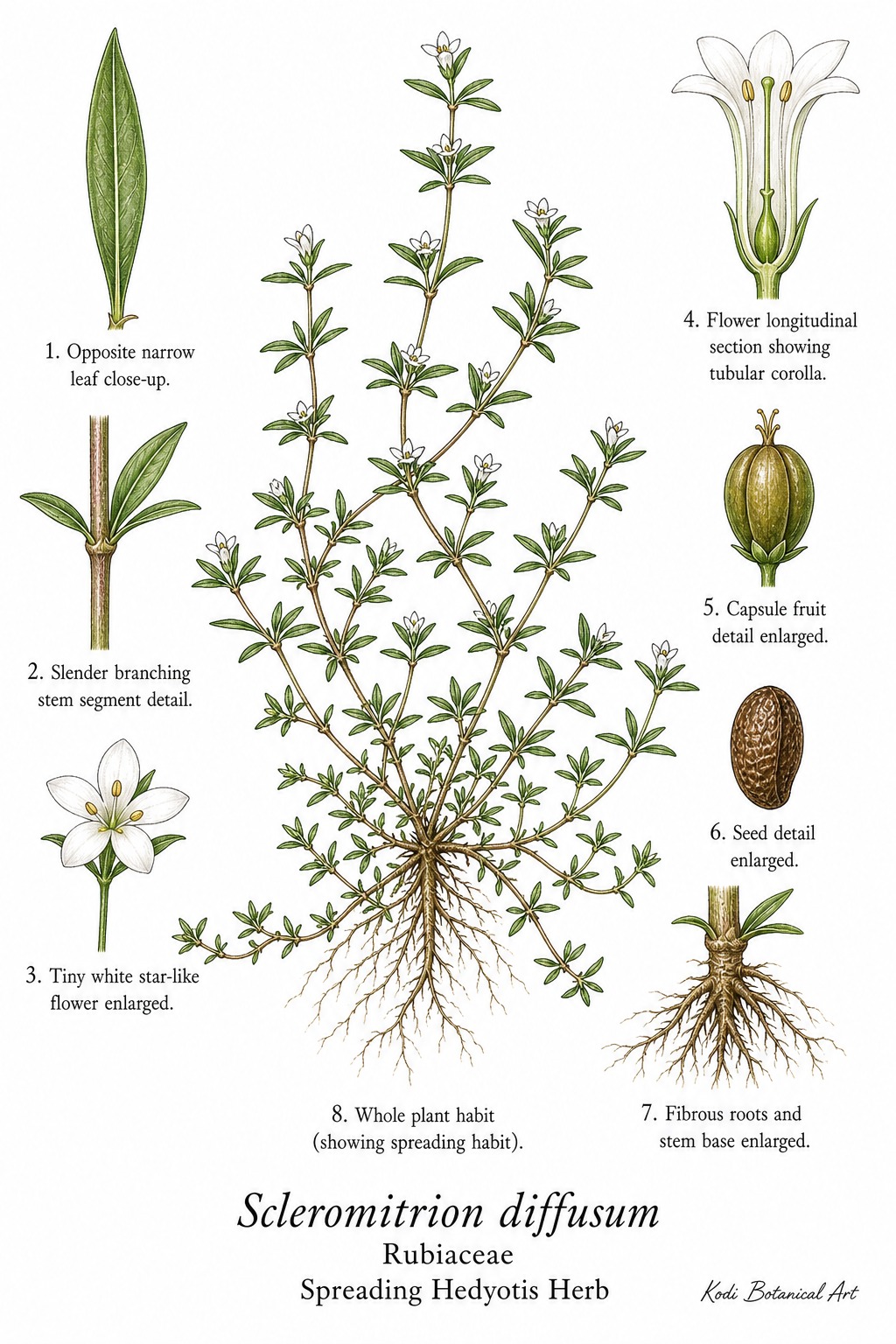
Known in TCM as Bai Hua She She Cao (白花蛇舌草), this slightly bitter and slightly sweet, cold herb enters the Liver, Stomach, and Large Intestine. Traditionally, it clears Heat and resolves toxicity, most often applied for cancer, appendicitis, and urinary tract infection. Modern research has identified Iridoid among its active constituents.
Part used: Whole herb
Also Known As
Latin: Herba Hedyotis Diffusae | Pinyin: Bai Hua She She Cao | Chinese: 白花蛇舌草
TCM Properties
- Taste
- slightly bitter, slightly sweet
- Temperature
- cold
- Channels
- Liver, Stomach, Large Intestine
Traditional Use
Primary Actions
- Clears Heat and resolves toxicity … principal anti-toxic herb for carbuncles, abscesses, appendicitis, snake bite, and cancer in modern TCM oncology protocols
- Promotes urination and reduces edema … urinary tract infection, hematuria, nephritis, and Damp-Heat in the Bladder
- Clears intestinal Heat and stops dysentery … intestinal abscess, bloody dysentery, and pelvic inflammatory disease
- Anti-inflammatory for skin and throat … tonsillitis, pharyngitis, boils, and infected wounds
Secondary Actions
- Modern oncology adjunct … widely combined with Ban Zhi Lian (Scutellaria barbata) and other Heat-clearing herbs in TCM cancer formulas; used alongside chemotherapy and radiation in Chinese integrative oncology
- Immunomodulatory … polysaccharide fraction enhances macrophage activity and NK cell function; used to support immune competence in cancer and chronic infection patients
Classic Formulas
- Bai Hua She She Cao + Ban Zhi Lian (Ban Zhi Lian-She She Cao formulation) … the most common two-herb combination in modern TCM oncology; clears Heat-toxin, invigorates Blood, reduces tumour-associated inflammation; used for liver, stomach, colon, and lung cancers in integrative Chinese cancer centres
- Combined with Long Dan Cao (龙胆草), Huang Qin, and Ze Xie in formulas for pelvic inflammatory disease, urethritis, and Damp-Heat strangury with pain
Classical References
- Guang Zhou Min Jian Cao Yao (广州民间草药): first systematic documentation of Bai Hua She She Cao as a principal south China folk herb for venomous snake bite, tonsillitis, appendicitis, and carbuncles … the name '白花蛇舌草' (white-flower snake-tongue herb) refers to the tiny white flowers on leaf-like bracts resembling a snake's tongue
- Quan Guo Zhong Cao Yao Hui Bian: records the herb for Heat-toxin patterns, urinary tract infection, nephritis, and cancer … notes the pairing with Ban Zhi Lian as a standard modern clinical combination for malignant disease
Modern Research
Active Compounds
- Iridoid glycosides: asperuloside, deacetyl-asperuloside, scandoside methyl ester (anti-inflammatory, immunomodulatory)
- Flavonoids: luteolin, quercetin, kaempferol, luteolin-7-glucoside (anti-inflammatory, pro-apoptotic)
- Oleanolic acid and ursolic acid (pentacyclic triterpenoids; anti-inflammatory, anti-proliferative, hepatoprotective)
- Phenolic acids: chlorogenic acid, caffeic acid, p-coumaric acid (antioxidant, antimicrobial)
- Polysaccharides (immunostimulatory; activates macrophages and NK cells)
- Stigmasterol and β-sitosterol (phytosterols; anti-inflammatory)
Studied Effects
- Anticancer … multiple pathways: iridoid glycosides, flavonoids, and triterpenoids from H. diffusa induce apoptosis in hepatocellular carcinoma, colorectal cancer, lung cancer, and cervical cancer cell lines via caspase activation, Bcl-2/Bax ratio modulation, and NF-κB suppression; anti-angiogenic effects via VEGF downregulation reduce tumour neovascularisation; extensive preclinical evidence across 20+ cancer cell types supports the oncology folk use
- Immunomodulatory: polysaccharide fraction from H. diffusa significantly enhances phagocytic activity of peritoneal macrophages, increases NK cell cytotoxicity, and elevates serum IgG/IgM levels in cyclophosphamide-immunosuppressed mice … provides mechanistic basis for the clinical combination with chemotherapy to support immune competence
- Anti-inflammatory and antimicrobial: luteolin and asperuloside inhibit COX-2, iNOS, and NF-κB in LPS-activated macrophage models; aqueous extract inhibits E. coli, S. aureus, and Pseudomonas aeruginosa … validates the appendicitis, UTI, and tonsillitis indications
Safety & Interactions
Contraindications
- Spleen-Stomach Deficiency Cold … cold-bitter nature strongly contraindicated with loose stools, poor appetite, and cold abdomen; prolonged use impairs digestive Yang
- Qi and Blood deficiency without Heat … inappropriate for deficiency patterns lacking toxic Heat presentation
Cautions
- Standard dose: 15–60 g dried herb in decoction; doses up to 120 g/day used in clinical oncology settings under supervision
- Generally considered safe at therapeutic doses with no major systemic toxicity documented in clinical use or animal studies
- Anticoagulants and antiplatelets: flavonoids and phenolic acids have mild antiplatelet activity … monitor bleeding parameters with concurrent use at very high doses
- Immunosuppressants: polysaccharide fraction enhances immune function; theoretical antagonism with immunosuppressant drugs (tacrolimus, cyclosporine) … avoid concurrent use without transplant physician review
- Pregnancy: cold-natured, large-dose use traditionally avoided in pregnancy; no formal teratogenicity data but caution advised
Drug Interactions
- Immunosuppressants (tacrolimus, cyclosporine) … polysaccharide immunostimulation may partially antagonise immunosuppression; monitor transplant patients
Conditions
- Cancer Research ★★★★☆ JSON
- Appendicitis Traditional ★★★★☆ JSON
- Urinary Tract Infection Traditional ★★★★☆ JSON
- Tonsillitis Traditional ★★★☆☆ JSON
- Hematuria Traditional ★★★☆☆ JSON
Frequently Asked Questions
What is Spreading Hedyotis Herb used for?
Spreading Hedyotis Herb is traditionally used to Clears Heat and resolves toxicity … principal anti-toxic herb for carbuncles, abscesses, appendicitis, snake bite, and cancer in modern TCM oncology protocols, Promotes urination and reduces edema … urinary tract infection, hematuria, nephritis, and Damp-Heat in the Bladder, Clears intestinal Heat and stops dysentery … intestinal abscess, bloody dysentery, and pelvic inflammatory disease, Anti-inflammatory for skin and throat … tonsillitis, pharyngitis, boils, and infected wounds. Research has investigated its effects on: Anticancer … multiple pathways: iridoid glycosides, flavonoids, and triterpenoids from H. diffusa induce apoptosis in hepatocellular carcinoma, colorectal cancer, lung cancer, and cervical cancer cell lines via caspase activation, Bcl-2/Bax ratio modulation, and NF-κB suppression; anti-angiogenic effects via VEGF downregulation reduce tumour neovascularisation; extensive preclinical evidence across 20+ cancer cell types supports the oncology folk use; Immunomodulatory: polysaccharide fraction from H. diffusa significantly enhances phagocytic activity of peritoneal macrophages, increases NK cell cytotoxicity, and elevates serum IgG/IgM levels in cyclophosphamide-immunosuppressed mice … provides mechanistic basis for the clinical combination with chemotherapy to support immune competence.
What are other names for Spreading Hedyotis Herb?
Spreading Hedyotis Herb is also known as Hedyotis. In TCM: 白花蛇舌草 (Bai Hua She She Cao); Herba Hedyotis Diffusae.
Is Spreading Hedyotis Herb safe during pregnancy?
The safety of Spreading Hedyotis Herb during pregnancy has not been established. Consult a qualified healthcare provider before use.
What are the contraindications for Spreading Hedyotis Herb?
Spreading Hedyotis Herb should not be used in: Spleen-Stomach Deficiency Cold … cold-bitter nature strongly contraindicated with loose stools, poor appetite, and cold abdomen; prolonged use impairs digestive Yang; Qi and Blood deficiency without Heat … inappropriate for deficiency patterns lacking toxic Heat presentation. Consult a qualified healthcare provider before use.
Does Spreading Hedyotis Herb interact with any medications?
Spreading Hedyotis Herb may interact with: Immunosuppressants (tacrolimus, cyclosporine) … polysaccharide immunostimulation may partially antagonise immunosuppression; monitor transplant patients. Always inform your healthcare provider of any herbal supplements you are taking.