Sikok Herb
- Chinese
- 小排草
- Pinyin
- Xiao Pai Cao
- Latin
- Radix Et Rhizoma Anisochili
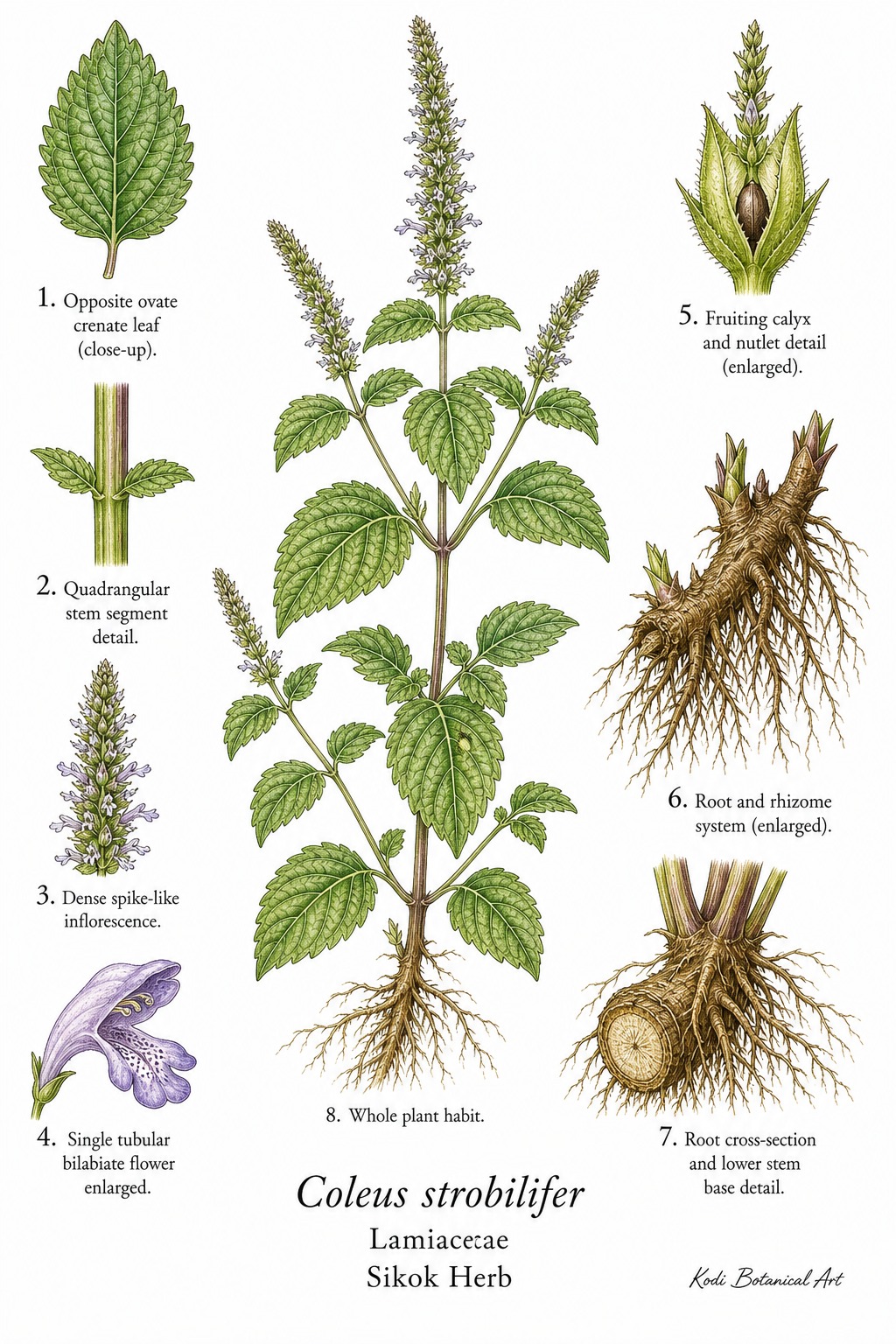
Known in TCM as Xiao Pai Cao (小排草), this pungent and sweet, warm herb enters the Kidney, Bladder, and Spleen. Traditionally, it promotes urination and resolves Dampness, most often applied for edema, rheumatism, and abdominal pain. Modern research has identified Essential among its active constituents.
Part used: Root
TCM Properties
- Taste
- pungent, sweet
- Temperature
- warm
- Channels
- Kidney, Bladder, Spleen
Traditional Use
Primary Actions
- Promotes urination and resolves Dampness … oliguria, edema, and Damp accumulation in the lower jiao
- Warms the Kidney and disperses Cold … cold-type lumbar pain, cold-Damp Bi syndrome affecting the lower body
- Regulates Qi and stops pain … abdominal distension and pain from Qi stagnation with Cold
- Dispels Wind-Cold-Damp … rheumatic muscle and joint aches
Secondary Actions
- Aromatic digestive … pungent volatile oil stimulates Spleen Yang and promotes digestion; used for poor appetite, nausea, and gastric distension in Yunnan and Guangxi folk medicine
- External use: aromatic fumigation or decoction wash for skin conditions and arthritis in southwest China folk practice
Classical References
- IMPORT NOTE: XLSX source filed this herb as 'All-Grass' but the Latin (Radix Et Rhizoma Anisochili) specifies root and rhizome as the official drug part … naming discrepancy retained as imported; Anisochilus carnosus (Wall.) Benth. is an aromatic Lamiaceae herb used in southwest China (Yunnan, Guangxi) and South Asia under the regional name Sikok or Pai Cao Xiang
- Yunnan Min Jian Cao Yao (云南民间草药): documents Xiao Pai Cao (Anisochilus spp.) as a pungent-warm Kidney-warming herb used in Yunnan folk medicine for cold-damp lumbar pain, difficult urination in cold patterns, and rheumatic joint aches; distinct from the broader 'Pai Cao' category (Lysimachia-based drainage herbs)
Modern Research
Active Compounds
- Essential oil: thymol, carvacrol, linalool, and monoterpene hydrocarbons (antimicrobial, anti-inflammatory, spasmolytic)
- Rosmarinic acid (phenylpropanoid ester; anti-inflammatory, antioxidant … characteristic of Lamiaceae)
- Luteolin and apigenin glycosides (flavonoids; anti-inflammatory)
- Ursolic acid and oleanolic acid (pentacyclic triterpenoids; anti-inflammatory, hepatoprotective)
- β-Sitosterol and stigmasterol (phytosterols)
Studied Effects
- Antimicrobial: essential oil from Anisochilus carnosus shows broad-spectrum antimicrobial activity against Staphylococcus aureus, Escherichia coli, and Candida albicans in disc-diffusion assays; thymol and carvacrol are the principal active components … consistent with the aromatic Heat-clearing and infection-resolving external applications in southwest China
- Anti-inflammatory: rosmarinic acid (a compound characteristic of aromatic Lamiaceae herbs) inhibits COX-2, 5-LOX, and NF-κB in in vitro inflammatory models; urinary tract anti-inflammatory activity is proposed as part of the diuretic-Damp-resolving mechanism in traditional applications
- Antioxidant and hepatoprotective: ursolic acid and rosmarinic acid from Lamiaceae herbs including Anisochilus demonstrate DPPH radical scavenging and hepatocyte protection against oxidative injury in standard assay panels; formal in vivo studies specific to A. carnosus remain limited
Safety & Interactions
Contraindications
- Yin Deficiency with Heat or Damp-Heat patterns … pungent-warm nature contraindicated when heat signs are present
- Excessive urination or Kidney Yang Deficiency with frequent clear urine … diuretic-warm action would further deplete fluids
Cautions
- Standard dose: 6–15 g dried root/rhizome in decoction
- Limited formal pharmacokinetic and safety studies; considered safe at traditional doses based on regional folk use
- Essential oil content: prolonged high-dose use may cause gastric irritation … take with food
- Pregnancy: pungent-warm herbs traditionally used with caution; insufficient clinical data for this species
Conditions
- Edema Traditional ★★★☆☆ JSON
- Rheumatism Traditional ★★★☆☆ JSON
- Abdominal Pain Traditional ★★☆☆☆ JSON
- Urinary Tract Infection Traditional ★★☆☆☆ JSON
Frequently Asked Questions
What is Sikok Herb used for?
Sikok Herb is traditionally used to Promotes urination and resolves Dampness … oliguria, edema, and Damp accumulation in the lower jiao, Warms the Kidney and disperses Cold … cold-type lumbar pain, cold-Damp Bi syndrome affecting the lower body, Regulates Qi and stops pain … abdominal distension and pain from Qi stagnation with Cold, Dispels Wind-Cold-Damp … rheumatic muscle and joint aches. Research has investigated its effects on: Antimicrobial: essential oil from Anisochilus carnosus shows broad-spectrum antimicrobial activity against Staphylococcus aureus, Escherichia coli, and Candida albicans in disc-diffusion assays; thymol and carvacrol are the principal active components … consistent with the aromatic Heat-clearing and infection-resolving external applications in southwest China; Anti-inflammatory: rosmarinic acid (a compound characteristic of aromatic Lamiaceae herbs) inhibits COX-2, 5-LOX, and NF-κB in in vitro inflammatory models; urinary tract anti-inflammatory activity is proposed as part of the diuretic-Damp-resolving mechanism in traditional applications.
Is Sikok Herb safe during pregnancy?
The safety of Sikok Herb during pregnancy has not been established. Consult a qualified healthcare provider before use.
What are the contraindications for Sikok Herb?
Sikok Herb should not be used in: Yin Deficiency with Heat or Damp-Heat patterns … pungent-warm nature contraindicated when heat signs are present; Excessive urination or Kidney Yang Deficiency with frequent clear urine … diuretic-warm action would further deplete fluids. Consult a qualified healthcare provider before use.