Shepherd's Purse Herb
- Chinese
- 荠菜
- Pinyin
- Ji Cai
- Latin
- Herba Capsellae
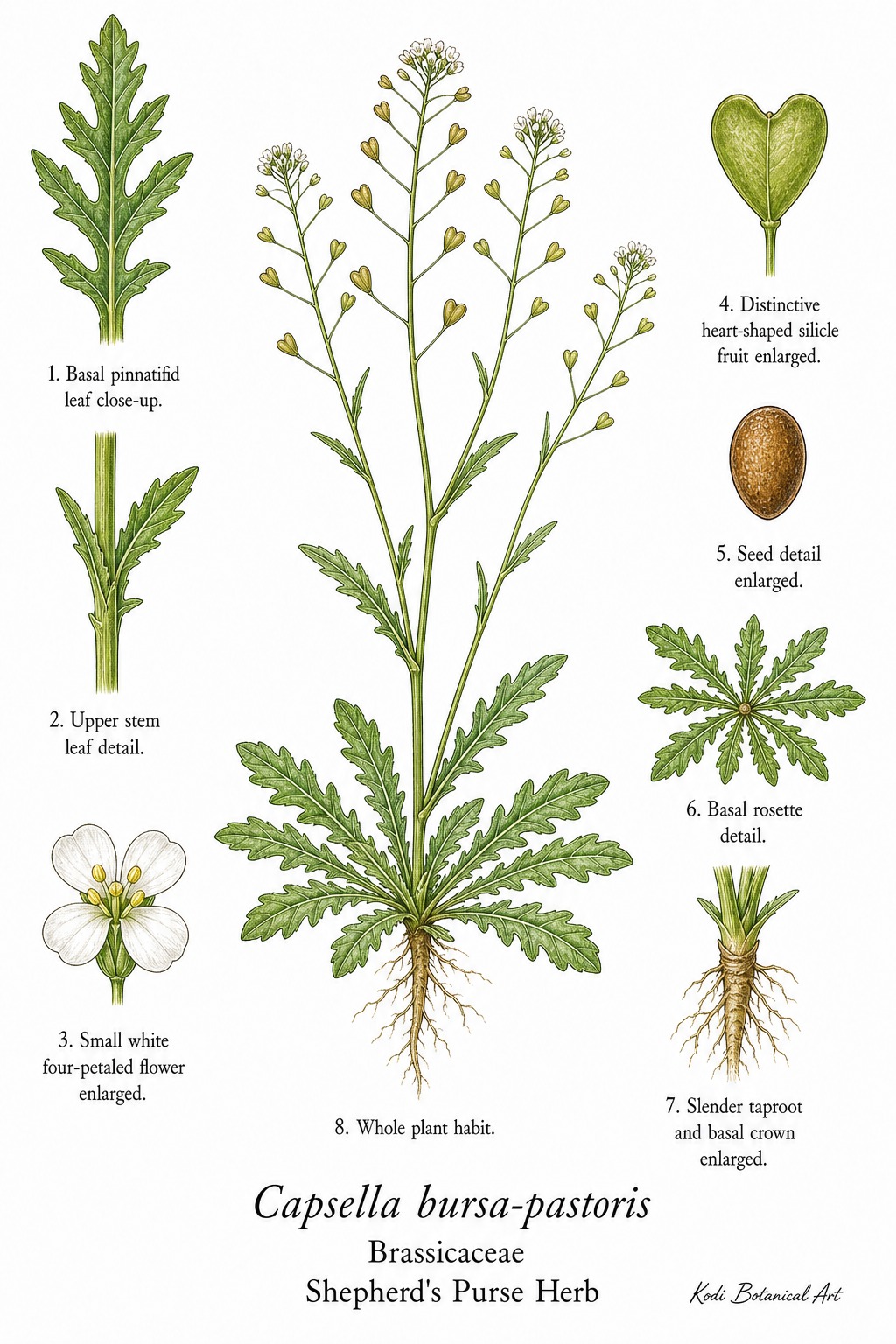
Known in TCM as Ji Cai (荠菜), this sweet and bland, cool herb enters the Liver, Heart, Lung, and Small Intestine. Traditionally, it stops bleeding, most often applied for uterine bleeding, hematuria, and urinary tract infection. Modern research has identified Diosmin among its active constituents.
Part used: Whole herb
Also Known As
Latin: Herba Capsellae | Pinyin: Ji Cai | Chinese: 荠菜
TCM Properties
- Taste
- sweet, bland
- Temperature
- cool
- Channels
- Liver, Heart, Lung, Small Intestine
Traditional Use
Primary Actions
- Stops bleeding … hemoptysis, hematuria, uterine bleeding (崩漏), epistaxis, and bloody dysentery due to Blood Heat or Qi failing to contain Blood
- Clears Heat and promotes urination … urinary tract infections, hematuria, scanty dark urine from Damp-Heat in the Bladder
- Clears Liver Heat and brightens the eyes … red, painful, or swollen eyes and visual disturbance from Liver Heat
- Benefits Stomach and stops diarrhea … diarrhea and dysentery from Damp-Heat in the Intestines
Secondary Actions
- Edible medicinal food … Ji Cai is one of the most commonly eaten medicinal vegetables in China; young leaves consumed in spring dumplings, soups, and stir-fries; recognised as both food and medicine since antiquity
- Reduces blood pressure … traditional folk use for hypertension; acetylcholine and choline content contribute to vasodilatory effect at high intake
Classic Formulas
- Ji Cai Zhi (荠菜汁) … fresh herb juice or strong decoction (30–60 g fresh herb) for acute uterine bleeding, hematuria, and epistaxis; classical single-herb formula widely referenced in folk gynaecology texts of the Ming and Qing dynasties
- Combined with Bai Mao Gen (白茅根) and Xiao Ji (小蓟) in formulas for hematuria and Bladder Heat strangury with bleeding
Classical References
- Shen Nong Ben Cao Jing: lists Ji Cai as a herb that 'benefits the five organs, brightens the eyes, and can be eaten as a vegetable' … placed in the middle grade for its dual food-medicine identity
- Ben Cao Gang Mu (Li Shizhen): 'Ji Cai cools blood, stops bleeding, regulates the middle jiao, benefits the liver qi, calms the heart, and brightens the eyes … it is an herb that can be taken every day without harm; the root is especially powerful for stopping uterine bleeding'
Modern Research
Active Compounds
- Diosmin and rutin (flavonoid glycosides; vascular-protective, reduce capillary fragility, haemostatic)
- Luteolin and quercetin (flavonoids; anti-inflammatory, antioxidant)
- Choline and acetylcholine (cholinergic agents; uterotonic, vasodilatory … explains haemostatic action via uterine contraction)
- Vitamin K1 (phylloquinone; activates clotting factors II, VII, IX, X … primary haemostatic mechanism)
- Bursinic acid (dicarboxylic acid; astringent)
- Glucosinolates (sinigrin, gluconapin … hydrolysed to isothiocyanates; antimicrobial, potential thyroid effect at very high intake)
- Fumaric acid, malic acid, tartaric acid (organic acids; metabolic support)
Studied Effects
- Haemostatic mechanisms: vitamin K1 activates clotting factor carboxylation (II, VII, IX, X pathway); simultaneously choline and acetylcholine content directly stimulate uterine smooth muscle contraction to reduce postpartum haemorrhage … two complementary mechanisms explain the longstanding gynaecological haemostasis application validated in both animal and clinical studies
- Anti-inflammatory and antioxidant: flavonoid fraction (diosmin, rutin, luteolin, quercetin) from C. bursa-pastoris significantly inhibits COX-2, reduces IL-6 and TNF-α, and scavenges DPPH radicals in in vitro assays; rutin protects vascular endothelium and reduces capillary permeability … mechanistic basis for the Heat-cooling and bleeding-stopping TCM profile
- Antihypertensive: aqueous extracts of C. bursa-pastoris produce significant blood-pressure reduction in hypertensive animal models via ACE inhibition and acetylcholine-mediated vasodilation; consistent with the traditional folk use for hypertension, though clinical trial evidence in humans remains limited
Safety & Interactions
Contraindications
- Pregnancy … acetylcholine and choline content stimulate uterine contractions; traditionally contraindicated in pregnancy due to uterotonic activity
- Cold-pattern bleeding without Heat signs (pale blood, cold abdomen, no fever) … cool-natured herb would worsen Cold deficiency bleeding
Cautions
- Standard dose: 15–30 g dried herb in decoction; 30–60 g fresh herb
- Anticoagulant medications (warfarin): high vitamin K1 content may reduce anticoagulant efficacy … monitor INR if consumed regularly in large quantities as a food herb
- Thyroid medications: very high daily intake (well above therapeutic doses) of glucosinolate-containing Brassicaceae plants may theoretically affect thyroid hormone synthesis; not a concern at standard therapeutic doses
- Generally considered safe at culinary and standard therapeutic doses based on millennia of continuous use as a vegetable across East Asia and the Mediterranean
Drug Interactions
- Warfarin and vitamin K antagonists … regular high-dose consumption may reduce anticoagulant effect via vitamin K1 content; monitor INR
Conditions
- Uterine Bleeding Traditional ★★★★☆ JSON
- Hematuria Traditional ★★★★☆ JSON
- Urinary Tract Infection Traditional ★★★☆☆ JSON
- Hypertension Traditional ★★★☆☆ JSON
- Conjunctivitis Traditional ★★☆☆☆ JSON
Frequently Asked Questions
What is Shepherd's Purse Herb used for?
Shepherd's Purse Herb is traditionally used to Stops bleeding … hemoptysis, hematuria, uterine bleeding (崩漏), epistaxis, and bloody dysentery due to Blood Heat or Qi failing to contain Blood, Clears Heat and promotes urination … urinary tract infections, hematuria, scanty dark urine from Damp-Heat in the Bladder, Clears Liver Heat and brightens the eyes … red, painful, or swollen eyes and visual disturbance from Liver Heat, Benefits Stomach and stops diarrhea … diarrhea and dysentery from Damp-Heat in the Intestines. Research has investigated its effects on: Haemostatic mechanisms: vitamin K1 activates clotting factor carboxylation (II, VII, IX, X pathway); simultaneously choline and acetylcholine content directly stimulate uterine smooth muscle contraction to reduce postpartum haemorrhage … two complementary mechanisms explain the longstanding gynaecological haemostasis application validated in both animal and clinical studies; Anti-inflammatory and antioxidant: flavonoid fraction (diosmin, rutin, luteolin, quercetin) from C. bursa-pastoris significantly inhibits COX-2, reduces IL-6 and TNF-α, and scavenges DPPH radicals in in vitro assays; rutin protects vascular endothelium and reduces capillary permeability … mechanistic basis for the Heat-cooling and bleeding-stopping TCM profile.
What are other names for Shepherd's Purse Herb?
Shepherd's Purse Herb is also known as Capsella. In TCM: 荠菜 (Ji Cai); Herba Capsellae.
Is Shepherd's Purse Herb safe during pregnancy?
Shepherd's Purse Herb is not recommended during pregnancy.
What are the contraindications for Shepherd's Purse Herb?
Shepherd's Purse Herb should not be used in: Pregnancy … acetylcholine and choline content stimulate uterine contractions; traditionally contraindicated in pregnancy due to uterotonic activity; Cold-pattern bleeding without Heat signs (pale blood, cold abdomen, no fever) … cool-natured herb would worsen Cold deficiency bleeding. Consult a qualified healthcare provider before use.
Does Shepherd's Purse Herb interact with any medications?
Shepherd's Purse Herb may interact with: Warfarin and vitamin K antagonists … regular high-dose consumption may reduce anticoagulant effect via vitamin K1 content; monitor INR. Always inform your healthcare provider of any herbal supplements you are taking.