Rhodiola Root and Rhizome
- Chinese
- 红景天
- Pinyin
- Hong Jing Tian
- Latin
- Radix Et Rhizoma Rhodiolae
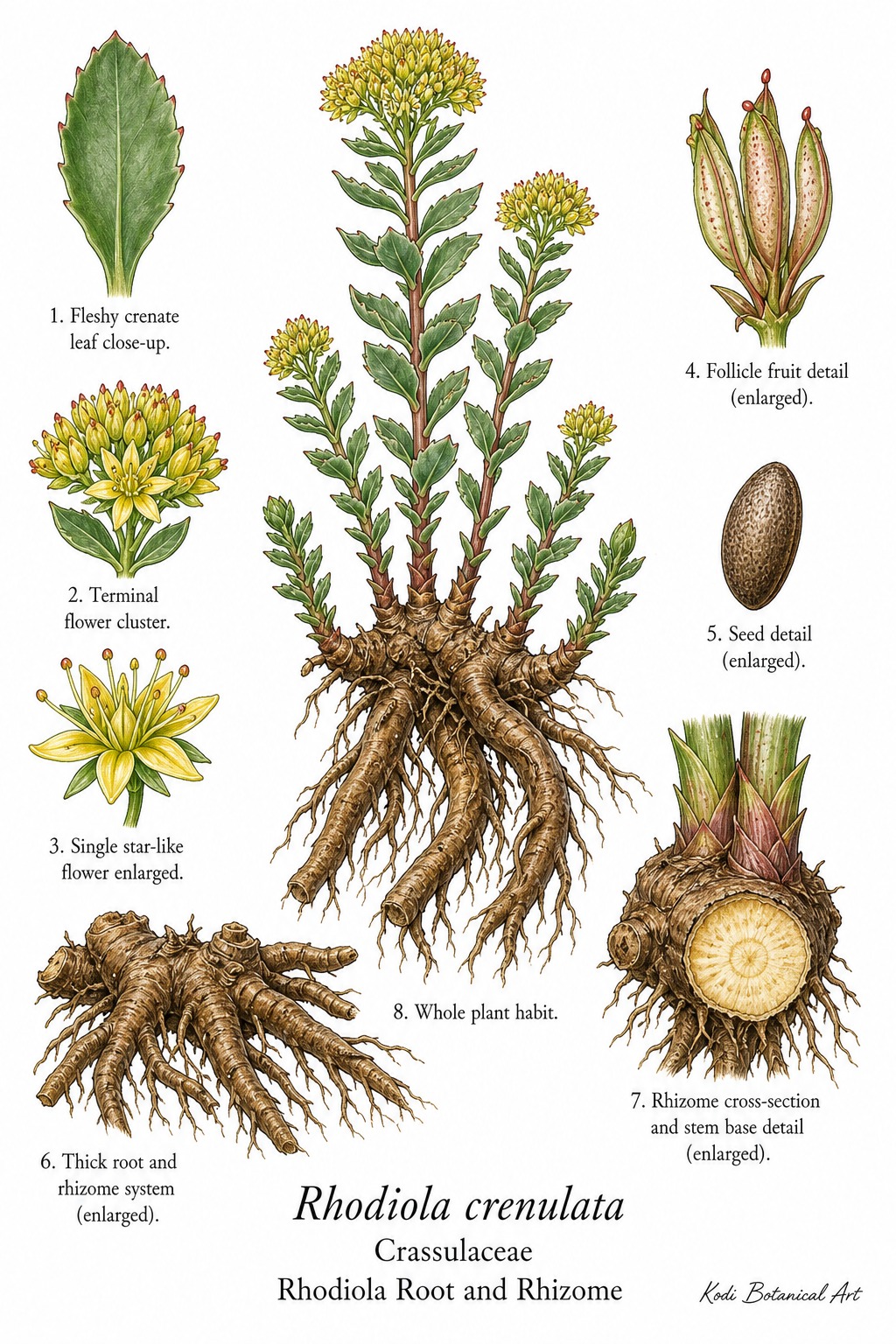
Known in TCM as Hong Jing Tian (红景天), this sweet and bitter and astringent, cold herb enters the Heart, Lung, and Spleen. Traditionally, it tonifies Qi and invigorates Blood, most often applied for fatigue, anxiety, and depression. Modern research has identified Salidroside (rhodioloside) among its active constituents.
Part used: Root
TCM Properties
- Taste
- sweet, bitter, astringent
- Temperature
- cold
- Channels
- Heart, Lung, Spleen
Traditional Use
Primary Actions
- Tonifies Qi and invigorates Blood … fatigue, altitude sickness, shortness of breath, and palpitations from Qi-Blood deficiency
- Clears Lung Heat and stops cough … Lung-heat cough, hemoptysis, and bronchitis
- Calms the Heart and settles the mind … palpitations, insomnia, anxiety, and mental fatigue from overwork
- Activates Blood and dispels stasis … traumatic injury, bruising, and chest pain from Blood stasis
Secondary Actions
- Tonifies Spleen Qi … poor appetite, loose stools, and weakness from Spleen Qi deficiency
- Adaptogenic tonic … foundational use in Tibetan and highland Chinese folk medicine for longevity, cold-climate endurance, and stress resilience
Classical References
- Si Bu Yi Dian (Crystal Mirror of the Four Tantras; Tibetan medical canon): records Hong Jing Tian as a high-altitude tonic that 'nourishes the heart, calms the mind, and enables one to withstand cold and exhaustion at altitude' … foundational text for its highland tonic use, predating integration into the Chinese pharmacopoeia
- IMPORT NOTE: XLSX source filed this herb under 'All-Grass' naming convention; the official Chinese Pharmacopoeia 2020 drug part is root and rhizome (Radix Et Rhizoma Rhodiolae), not aerial parts … official species is Rhodiola crenulata (Hook.f. & Thomson) H.Ohba; Latin and pinyin confirm the root drug; data retained as imported from source XLSX
Modern Research
Active Compounds
- Salidroside (rhodioloside) … phenylpropanoid glycoside; principal bioactive marker; anti-fatigue, neuroprotective, adaptogenic
- Rosavins (rosavin, rosarin, rosin) … phenylpropanoid glycosides specific to Rhodiola rosea; adaptogenic, antidepressant; used as standardisation marker alongside salidroside
- Tyrosol … simple phenol precursor to salidroside; antioxidant
- Herbacetin, rhodionin, tricin … flavonoids; anti-inflammatory, weak anticancer activity
- Monoterpene alcohols (geraniol, myrtenol) … essential oil components
- Organic acids: gallic acid, chlorogenic acid, oxalic acid
Studied Effects
- Antidepressant: randomised controlled trial comparing R. rosea extract (340 mg/day), sertraline (50 mg/day), and placebo in 57 outpatients with mild-to-moderate major depressive disorder found comparable Hamilton Depression Rating Scale improvement between Rhodiola and sertraline groups with significantly fewer adverse effects in the Rhodiola group … first RCT evidence supporting the TCM calming and mind-settling application (PMID 25539889)
- Adaptogenic and anti-fatigue: salidroside and rosavins reduce stress-induced cortisol elevation, improve work capacity, and shorten recovery time in both clinical and animal studies; mechanism involves AMPK activation, SIRT1 upregulation, and attenuated HPA-axis reactivity … directly validates the Qi-tonifying fatigue and altitude-stress applications
- Altitude sickness and hypoxia adaptation: used by Chinese military and Tibetan highland communities for hypoxia adaptation; salidroside protects mitochondrial function, reduces ROS generation, and upregulates hypoxia-inducible factor (HIF-1α) under low-oxygen conditions … provides mechanistic basis for the primary indication of altitude-related fatigue and shortness of breath
- CYP3A4 pharmacokinetic interaction: in vitro studies show rosavins inhibit CYP3A4-mediated drug metabolism, raising the possibility of elevated plasma concentrations of co-administered CYP3A4-substrate medications; clinical significance at standard oral doses remains unclear but monitoring is warranted
PubMed References
Safety & Interactions
Contraindications
- Concurrent MAOI therapy … theoretical monoaminergic potentiation; avoid combination
- Bipolar disorder … stimulating and adaptogenic properties may precipitate manic episodes; use only under specialist supervision
Cautions
- Standard dose: 200–600 mg standardised extract (3% rosavins, 1% salidroside); traditional decoction 3–9 g dried root
- SSRIs and SNRIs (fluoxetine, sertraline, venlafaxine): salidroside modulates serotonin reuptake transporter; additive serotonergic effect is theoretical but case reports exist … monitor for serotonin syndrome signs (agitation, hyperreflexia, hyperthermia)
- Anticoagulants and antiplatelets (warfarin, aspirin, clopidogrel): platelet aggregation inhibition reported in vitro; increased bleeding risk with concurrent use
- CYP3A4-substrate drugs (statins, immunosuppressants, calcium-channel blockers, some antivirals): rosavins may inhibit CYP3A4 … monitor for signs of elevated drug levels
- Stimulants (caffeine, ephedrine, methylphenidate): additive CNS stimulation; risk of insomnia, agitation, and elevated blood pressure
- Antidiabetic medications (insulin, metformin, sulfonylureas): additive glucose-lowering; monitor blood glucose
- Pregnancy: insufficient safety data; avoid
Drug Interactions
- SSRIs/SNRIs … additive serotonergic effect; monitor for serotonin syndrome
- MAO inhibitors … contraindicated; serotonergic potentiation
- Anticoagulants/antiplatelets … enhanced bleeding risk via platelet inhibition
- CYP3A4 substrates … rosavin-mediated inhibition may elevate plasma drug levels
- Antidiabetics … additive hypoglycemic effect
Conditions
- Fatigue Research ★★★★★ JSON
- Anxiety Research ★★★★☆ JSON
- Depression Research ★★★★☆ JSON
- Insomnia Traditional ★★★☆☆ JSON
- Altitude Sickness Traditional ★★★★☆ JSON
Frequently Asked Questions
What is Rhodiola Root and Rhizome used for?
Rhodiola Root and Rhizome is traditionally used to Tonifies Qi and invigorates Blood … fatigue, altitude sickness, shortness of breath, and palpitations from Qi-Blood deficiency, Clears Lung Heat and stops cough … Lung-heat cough, hemoptysis, and bronchitis, Calms the Heart and settles the mind … palpitations, insomnia, anxiety, and mental fatigue from overwork, Activates Blood and dispels stasis … traumatic injury, bruising, and chest pain from Blood stasis. Research has investigated its effects on: Antidepressant: randomised controlled trial comparing R. rosea extract (340 mg/day), sertraline (50 mg/day), and placebo in 57 outpatients with mild-to-moderate major depressive disorder found comparable Hamilton Depression Rating Scale improvement between Rhodiola and sertraline groups with significantly fewer adverse effects in the Rhodiola group … first RCT evidence supporting the TCM calming and mind-settling application (PMID 25539889); Adaptogenic and anti-fatigue: salidroside and rosavins reduce stress-induced cortisol elevation, improve work capacity, and shorten recovery time in both clinical and animal studies; mechanism involves AMPK activation, SIRT1 upregulation, and attenuated HPA-axis reactivity … directly validates the Qi-tonifying fatigue and altitude-stress applications.
Is Rhodiola Root and Rhizome safe during pregnancy?
Rhodiola Root and Rhizome is not recommended during pregnancy. Pregnancy: insufficient safety data; avoid
What are the contraindications for Rhodiola Root and Rhizome?
Rhodiola Root and Rhizome should not be used in: Concurrent MAOI therapy … theoretical monoaminergic potentiation; avoid combination; Bipolar disorder … stimulating and adaptogenic properties may precipitate manic episodes; use only under specialist supervision. Consult a qualified healthcare provider before use.
Does Rhodiola Root and Rhizome interact with any medications?
Rhodiola Root and Rhizome may interact with: SSRIs/SNRIs … additive serotonergic effect; monitor for serotonin syndrome; MAO inhibitors … contraindicated; serotonergic potentiation; Anticoagulants/antiplatelets … enhanced bleeding risk via platelet inhibition; CYP3A4 substrates … rosavin-mediated inhibition may elevate plasma drug levels. Always inform your healthcare provider of any herbal supplements you are taking.