Little Plantain Herb
- Chinese
- 小车前
- Pinyin
- Xiao Che Qian
- Latin
- Herba Plantaginis Minutae
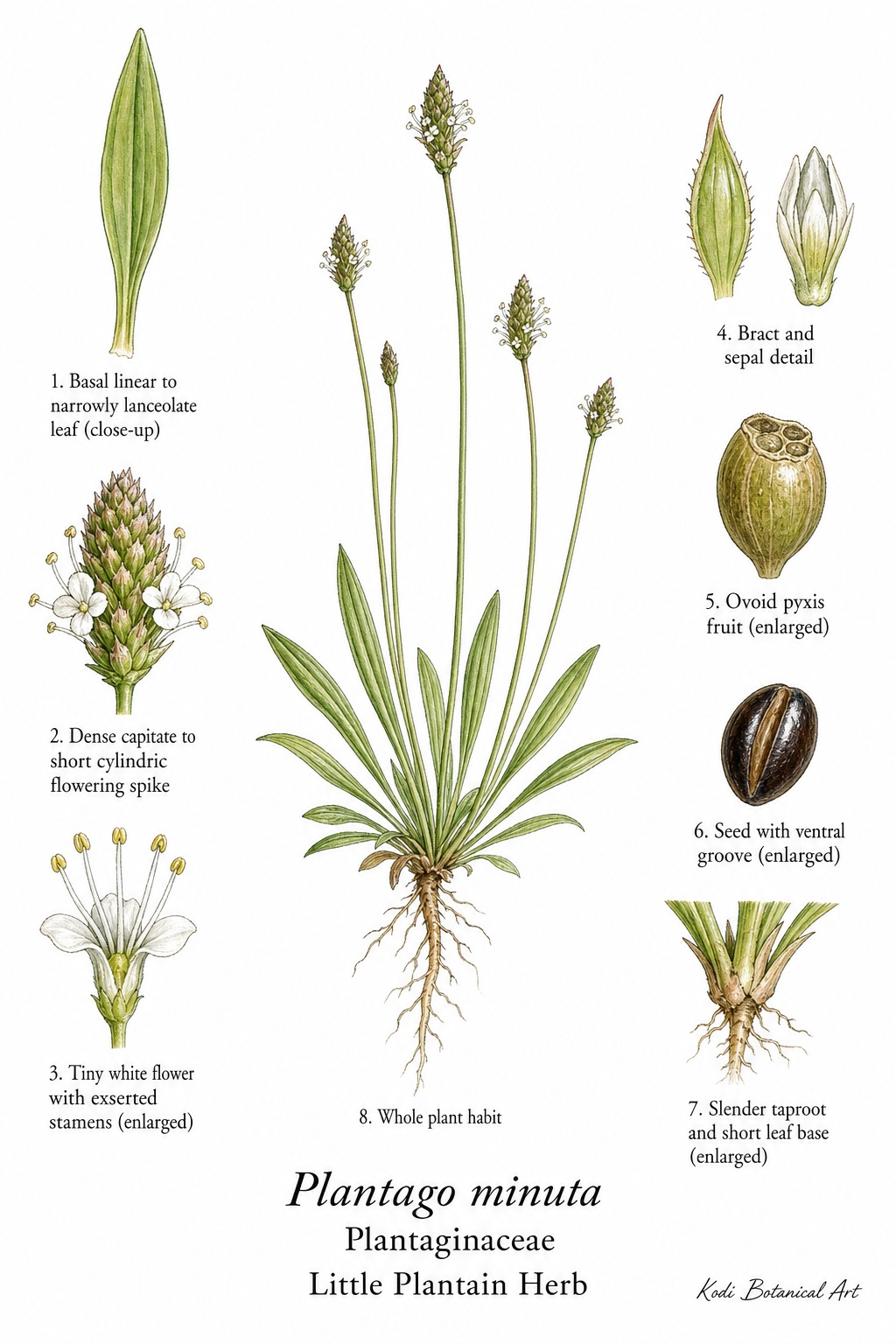
Known in TCM as Xiao Che Qian (小车前), this sweet, cold herb enters the Kidney, Liver, Lung, and Small Intestine. Traditionally, it promotes urination and clears Damp-Heat from the lower burner, most often applied for urinary tract infection, edema, and conjunctivitis. Modern research has identified Aucubin among its active constituents.
Part used: Whole herb
Also Known As
Latin: Herba Plantaginis Minutae | Pinyin: Xiao Che Qian | Chinese: 小车前
TCM Properties
- Taste
- sweet
- Temperature
- cold
- Channels
- Kidney, Liver, Lung, Small Intestine
Traditional Use
Primary Actions
- Promotes urination and clears Damp-Heat from the lower burner
- Clears Liver Heat and benefits vision … eye inflammation, conjunctivitis
- Clears Lung Heat and dissolves phlegm … cough with heat signs
- Cools Blood and stops bleeding … hematuria, nosebleed
Secondary Actions
- Treats summer-heat diarrhea … clears heat while promoting urination to separate clear and turbid
- Minor diuretic for edema and oliguria
Classical References
- Xiao Che Qian (小车前, Plantago minuta) shares its therapeutic profile with the primary Plantago herbs of TCM: Che Qian Cao (车前草, Herba Plantaginis, P. asiatica or P. depressa) and Che Qian Zi (车前子, Semen Plantaginis). All three promote urination, clear Liver Heat, and benefit vision … the smaller species is used regionally when the main species is unavailable and is regarded as interchangeable at equivalent doses
- Classical indication: 'Separates clear from turbid in the lower burner' … promotes urination while simultaneously treating Damp-Heat diarrhea by redirecting Dampness into the urine rather than the intestines; a classic strategy in TCM water metabolism
Modern Research
Active Compounds
- Aucubin (iridoid glycoside; principal anti-inflammatory and diuretic compound across Plantago species)
- Acteoside / verbascoside (phenylethanoid glycoside; antioxidant, anti-inflammatory)
- Plantaginin (flavonoid glycoside)
- Quercetin and quercetin glycosides
- Mucilage polysaccharides (diuretic and demulcent)
- Chlorogenic acid and caffeic acid
Studied Effects
- Genus-level pharmacology (Plantago): aucubin inhibits NF-κB and COX-2, reducing prostaglandin synthesis; acteoside shows potent antioxidant activity (DPPH IC50 comparable to ascorbic acid) and inhibits LPS-induced TNF-α in macrophages … consistent with heat-clearing and anti-inflammatory TCM actions
- Diuretic: mucilage polysaccharides increase urinary output in rodent models via osmotic mechanism; aucubin contributes mild tubular diuretic effect
- Note: dedicated pharmacological studies for P. minuta specifically are sparse; the bioactive profile above is extrapolated from well-characterised Plantago species (P. major, P. asiatica, P. depressa) which share the same principal compound classes
PubMed References
Safety & Interactions
Contraindications
- Kidney Yang Deficiency with cold and edema (cold-type water metabolism disorder)
- Spleen-Stomach Deficiency Cold with loose stools
Cautions
- Standard dose 9–15g dried herb; 30–60g fresh herb
- Pharmacological data for P. minuta specifically is limited … regarded as therapeutically equivalent to Che Qian Cao at comparable doses; monitor clinical response
- Long-term high-dose use not evaluated; standard short-term use at therapeutic doses considered safe based on genus-level data
Conditions
- Urinary Tract Infection Traditional ★★★☆☆ JSON
- Edema Traditional ★★★☆☆ JSON
- Conjunctivitis Traditional ★★★☆☆ JSON
- Cough Traditional ★★☆☆☆ JSON
- Diarrhea Traditional ★★☆☆☆ JSON
Frequently Asked Questions
What is Little Plantain Herb used for?
Little Plantain Herb is traditionally used to Promotes urination and clears Damp-Heat from the lower burner, Clears Liver Heat and benefits vision … eye inflammation, conjunctivitis, Clears Lung Heat and dissolves phlegm … cough with heat signs, Cools Blood and stops bleeding … hematuria, nosebleed. Research has investigated its effects on: Genus-level pharmacology (Plantago): aucubin inhibits NF-κB and COX-2, reducing prostaglandin synthesis; acteoside shows potent antioxidant activity (DPPH IC50 comparable to ascorbic acid) and inhibits LPS-induced TNF-α in macrophages … consistent with heat-clearing and anti-inflammatory TCM actions; Diuretic: mucilage polysaccharides increase urinary output in rodent models via osmotic mechanism; aucubin contributes mild tubular diuretic effect.
What are other names for Little Plantain Herb?
Little Plantain Herb is also known as Plantaginis. In TCM: 小车前 (Xiao Che Qian); Herba Plantaginis Minutae.
Is Little Plantain Herb safe during pregnancy?
The safety of Little Plantain Herb during pregnancy has not been established. Consult a qualified healthcare provider before use.
What are the contraindications for Little Plantain Herb?
Little Plantain Herb should not be used in: Kidney Yang Deficiency with cold and edema (cold-type water metabolism disorder); Spleen-Stomach Deficiency Cold with loose stools. Consult a qualified healthcare provider before use.