Lilac Pink Herb
- Chinese
- 瞿麦
- Pinyin
- Qu Mai
- Latin
- Herba Dianthi
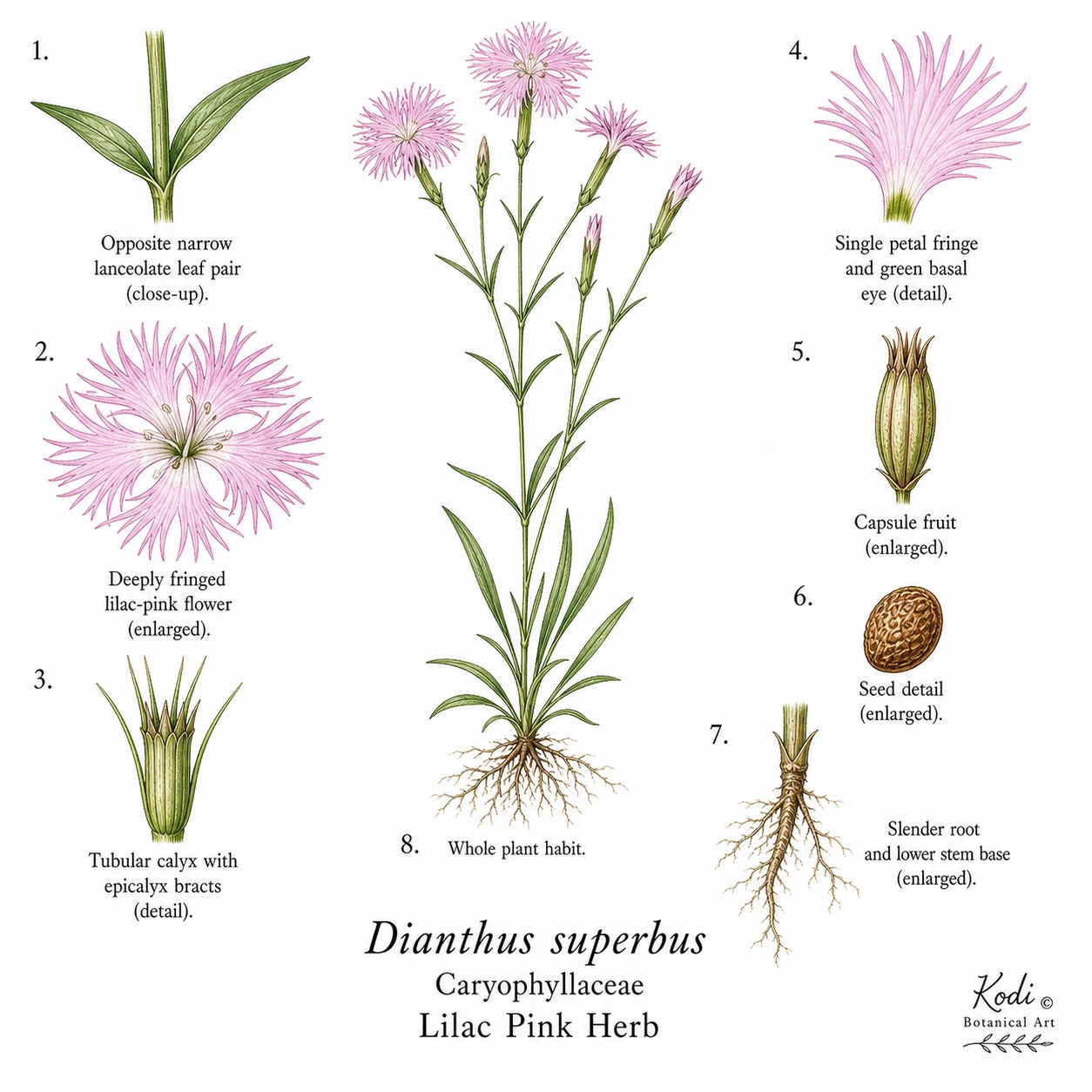
Known in TCM as Qu Mai (瞿麦), this bitter, cold herb enters the Heart, Small Intestine, and Bladder. Traditionally, it promotes urination and drains Damp-Heat, most often applied for urinary tract infection, nephrolithiasis, and dysmenorrhea. Modern research has identified Triterpenoid saponins (oleanane-type; principal bioactives among its active constituents.
Part used: Whole herb
Also Known As
Latin: Herba Dianthi | Pinyin: Qu Mai | Chinese: 瞿麦
TCM Properties
- Taste
- bitter
- Temperature
- cold
- Channels
- Heart, Small Intestine, Bladder
Traditional Use
Primary Actions
- Promotes urination and drains Damp-Heat … primary herb for heat strangury (Lin Zheng)
- Clears Heart Fire and drains it through the Small Intestine to the Bladder
- Breaks Blood stasis and promotes menstruation
- Treats stone strangury (Shi Lin) and bloody strangury (Xue Lin)
Secondary Actions
- Anti-inflammatory for lower urinary tract … acute cystitis, urethritis, pyelonephritis
- Immunomodulatory … a non-polar fraction suppresses alloreactive T cells while generating Treg; relevant to Lin-type autoimmune/inflammatory presentations
Classic Formulas
- Ba Zheng San (八正散) … the classic formula for acute Heat-type strangury; Qu Mai combined with Bian Xu, Che Qian Zi, Hua Shi, Zhi Zi, Mu Tong, Da Huang, and Deng Xin Cao to flush Damp-Heat from the lower burner
- Zhu Ling Qu Mai Tang (猪苓瞿麦汤) … for urinary difficulty with water retention; Qu Mai paired with Zhu Ling, Fu Ling, Ze Xie, and Fu Zi
Classical References
- Shen Nong Ben Cao Jing (Divine Husbandman's Classic): lists Qu Mai as principal herb for treating Lin Zheng (strangury) … its inclusion in the foundational pharmacopoeia reflects centuries of empirical validation for urinary Damp-Heat
- Ben Cao Gang Mu (Li Shizhen): 'Qu Mai clears Heart Fire, drains Bladder Damp-Heat, promotes urination, and breaks Blood stasis … the foremost herb for painful dribbling urination, bloody urine, and stone strangury'
Modern Research
Active Compounds
- Triterpenoid saponins (oleanane-type; principal bioactives … 19 identified in D. superbus)
- Dianosides A–F (triterpenoid saponins with analgesic and hepatoprotective activity)
- C-glycosylflavones: vicenin-2 (apigenin-6,8-di-C-glucoside), orientin, isovitexin
- Anthocyanins (pigment)
- Methyl salicylate and eugenol (volatile oil fraction)
- Cyclic peptides (dianthins)
- Sterols (β-sitosterol)
Studied Effects
- Comprehensive review: 194 compounds identified across Dianthus species; pharmacological activities confirmed include diuretic, anti-inflammatory, antiviral (anti-influenza A), anticancer, antioxidant, antimicrobial, immunomodulatory, neuroprotective, and anti-diabetic nephropathy effects (PMID 35062995)
- Anti-influenza and antioxidant: ethanol extract of D. superbus shows significant inhibition of influenza A virus replication in MDCK cells and potent DPPH radical scavenging; saponins and flavonoids identified as active fractions (PMID 30654095)
- Immunosuppressive: non-polar dichloromethane fraction suppresses naïve and memory alloreactive T cells while directly generating regulatory T cells (Treg) … dual immunomodulatory mechanism distinct from conventional immunosuppressants (PMC3640757)
PubMed References
Safety & Interactions
Contraindications
- Pregnancy … Qu Mai strongly breaks Blood stasis and promotes downward-draining; risk of miscarriage
- Cold-Damp strangury (Lin Zheng without heat signs … clear urine, cold body, no fever)
- Spleen-Stomach Deficiency Cold with loose stools
Cautions
- Standard dose 9–15g decoction
- Immunosuppressive activity in vitro (T-cell inhibition); caution in patients on pharmaceutical immunosuppressants … potential additive effect; avoid in known immunodeficiency
- Herba Dianthi covers two pharmacopoeial species: Dianthus superbus L. (瞿麦) and Dianthus chinensis L. (石竹); both are used interchangeably in clinical practice with similar safety profiles
Classic formulas that use Lilac Pink Herb
Herbs are rarely taken alone in Chinese medicine. These formula pages show what this herb does inside a classic prescription and which pattern that prescription is chosen for.
Conditions
- Urinary Tract Infection Traditional ★★★★★ JSON
- Nephrolithiasis Traditional ★★★★☆ JSON
- Dysmenorrhea Traditional ★★★☆☆ JSON
- Edema Traditional ★★★☆☆ JSON
- Hematuria Traditional ★★★☆☆ JSON
Frequently Asked Questions
What is Lilac Pink Herb used for?
Lilac Pink Herb is traditionally used to Promotes urination and drains Damp-Heat … primary herb for heat strangury (Lin Zheng), Clears Heart Fire and drains it through the Small Intestine to the Bladder, Breaks Blood stasis and promotes menstruation, Treats stone strangury (Shi Lin) and bloody strangury (Xue Lin). Research has investigated its effects on: Comprehensive review: 194 compounds identified across Dianthus species; pharmacological activities confirmed include diuretic, anti-inflammatory, antiviral (anti-influenza A), anticancer, antioxidant, antimicrobial, immunomodulatory, neuroprotective, and anti-diabetic nephropathy effects (PMID 35062995); Anti-influenza and antioxidant: ethanol extract of D. superbus shows significant inhibition of influenza A virus replication in MDCK cells and potent DPPH radical scavenging; saponins and flavonoids identified as active fractions (PMID 30654095).
What are other names for Lilac Pink Herb?
Lilac Pink Herb is also known as Dianthi. In TCM: 瞿麦 (Qu Mai); Herba Dianthi.
Is Lilac Pink Herb safe during pregnancy?
Lilac Pink Herb is not recommended during pregnancy.
What are the contraindications for Lilac Pink Herb?
Lilac Pink Herb should not be used in: Pregnancy … Qu Mai strongly breaks Blood stasis and promotes downward-draining; risk of miscarriage; Cold-Damp strangury (Lin Zheng without heat signs … clear urine, cold body, no fever); Spleen-Stomach Deficiency Cold with loose stools. Consult a qualified healthcare provider before use.