Tian Ji Huang (Japanese St. Johnswort … Synonym)
- Chinese
- 田基黄
- Pinyin
- Tian Ji Huang
- Latin
- Herba Hyperici Japonici
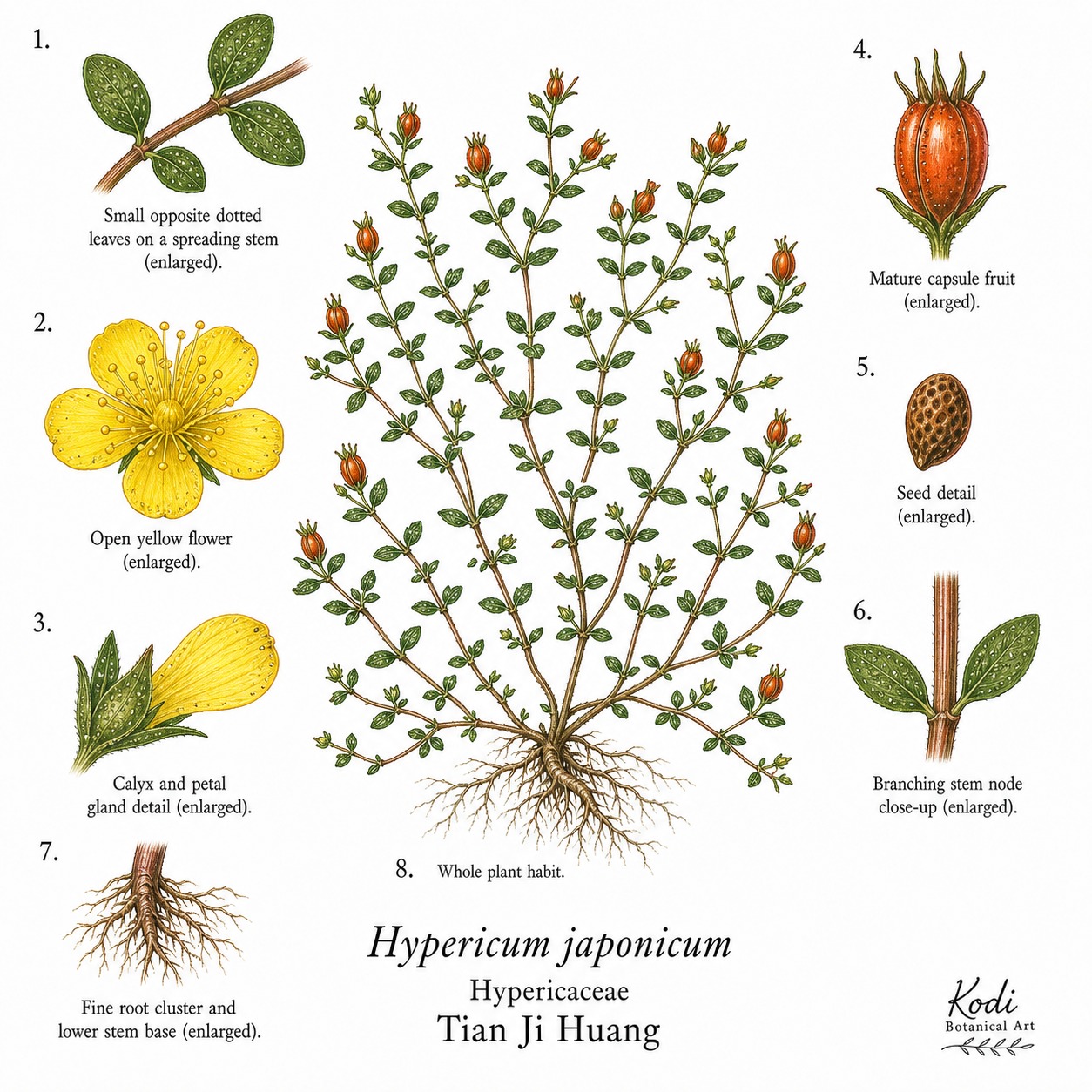
Known in TCM as Tian Ji Huang (田基黄), this bitter and sweet, cool herb enters the Lung, Liver, Kidney, and Bladder. Traditionally, it clears Heat and resolves toxicity, most often applied for hepatitis, jaundice, and urinary tract infection. Modern research has identified Quercetin among its active constituents.
Part used: Whole herb
Also Known As
Latin: Herba Hyperici Japonici | Pinyin: Tian Ji Huang | Chinese: 田基黄
TCM Properties
- Taste
- bitter, sweet
- Temperature
- cool
- Channels
- Lung, Liver, Kidney, Bladder
Traditional Use
Primary Actions
- Clears Heat and resolves toxicity
- Promotes urination and treats Damp-Heat jaundice
- Disperses Blood stasis and reduces swelling
- Clears Lung Heat … used for cough, hemoptysis, and lung abscess
Secondary Actions
- Anti-inflammatory for hepatitis and cholecystitis … key clinical use
- External application for traumatic injury, furuncles, snakebite, and infected wounds
Classical References
- SYNONYM NOTE: Tian Ji Huang (田基黄, 'Field Base Yellow') is an alternate folk name … predominantly used in Guangdong, Fujian, and other southern Chinese provinces … for the same plant as Di Er Cao (地耳草, herb #55). Both names refer to Hypericum japonicum Thunb. ex Murray. This entry was imported as a separate record in the source XLSX; the primary monograph for this species is herb #55 (all-grass-of-japanese-st-johnswort). All pharmacological and safety data are shared with that entry.
- Tian Ji Huang (田基黄) is the name most commonly cited in modern Chinese clinical literature and hospital formularies for infectious hepatitis; Di Er Cao (地耳草) is the name more commonly found in classical materia medica texts
Modern Research
Active Compounds
- Quercetin
- Quercitrin (quercetin-3-rhamnoside)
- Isoquercitrin (quercetin-3-glucoside)
- Kaempferol
- Tetramethoxyluteolin (5,7,3′,4′-tetramethoxyflavone; hepatoprotective)
- Hypericin and pseudohypericin (trace levels; much lower than H. perforatum)
- Chlorogenic acid
- Xanthones (trace)
Studied Effects
- Hepatoprotective in cholestatic hepatitis: network pharmacology identified quercetin as a central multi-target node acting on PTGS2 (COX-2), BCL2, CYP7A1, and FXR pathways; molecular docking confirmed direct binding … provides mechanistic basis for classical Damp-Heat jaundice indication (PMID 33657087)
- Anti-hepatitis B: Di Er Cao / Tian Ji Huang extract and isolated flavonoids inhibit HBsAg and HBeAg secretion in HepG2.2.15 cells; tetramethoxyluteolin identified as the most active compound
- Anti-inflammatory and antioxidant: total flavonoids reduce LPS-induced NO, IL-6, and TNF-α in RAW264.7 macrophages
PubMed References
Safety & Interactions
Contraindications
- Cold-Damp jaundice or diarrhea (no fever, pale jaundice, cold limbs)
- Spleen-Stomach Deficiency Cold
Cautions
- Standard dose 15–60g fresh herb; 15–30g dried in decoction
- This entry (herb #57, Tian Ji Huang) is a synonym of herb #55 (Di Er Cao, all-grass-of-japanese-st-johnswort) … same species, same safety profile
- Do NOT confuse with Hypericum perforatum (Western St John's Wort) … H. japonicum does not share the CYP3A4 induction or hypericin-mediated drug interactions of the Western species
Conditions
- Hepatitis Research ★★★★★ JSON
- Jaundice Traditional ★★★★☆ JSON
- Urinary Tract Infection Traditional ★★★☆☆ JSON
- Upper Respiratory Infection Traditional ★★★☆☆ JSON
- Dysentery Traditional ★★☆☆☆ JSON
Frequently Asked Questions
What is Tian Ji Huang (Japanese St. Johnswort … Synonym) used for?
Tian Ji Huang (Japanese St. Johnswort … Synonym) is traditionally used to Clears Heat and resolves toxicity, Promotes urination and treats Damp-Heat jaundice, Disperses Blood stasis and reduces swelling, Clears Lung Heat … used for cough, hemoptysis, and lung abscess. Research has investigated its effects on: Hepatoprotective in cholestatic hepatitis: network pharmacology identified quercetin as a central multi-target node acting on PTGS2 (COX-2), BCL2, CYP7A1, and FXR pathways; molecular docking confirmed direct binding … provides mechanistic basis for classical Damp-Heat jaundice indication (PMID 33657087); Anti-hepatitis B: Di Er Cao / Tian Ji Huang extract and isolated flavonoids inhibit HBsAg and HBeAg secretion in HepG2.2.15 cells; tetramethoxyluteolin identified as the most active compound.
What are other names for Tian Ji Huang (Japanese St. Johnswort … Synonym)?
Tian Ji Huang (Japanese St. Johnswort … Synonym) is also known as Hyperici. In TCM: 田基黄 (Tian Ji Huang); Herba Hyperici Japonici.
Is Tian Ji Huang (Japanese St. Johnswort … Synonym) safe during pregnancy?
The safety of Tian Ji Huang (Japanese St. Johnswort … Synonym) during pregnancy has not been established. Consult a qualified healthcare provider before use.
What are the contraindications for Tian Ji Huang (Japanese St. Johnswort … Synonym)?
Tian Ji Huang (Japanese St. Johnswort … Synonym) should not be used in: Cold-Damp jaundice or diarrhea (no fever, pale jaundice, cold limbs); Spleen-Stomach Deficiency Cold. Consult a qualified healthcare provider before use.