Japanese Hop
- Chinese
- 葎草
- Pinyin
- Lü Cao
- Latin
- Herba Humuli Scandentis
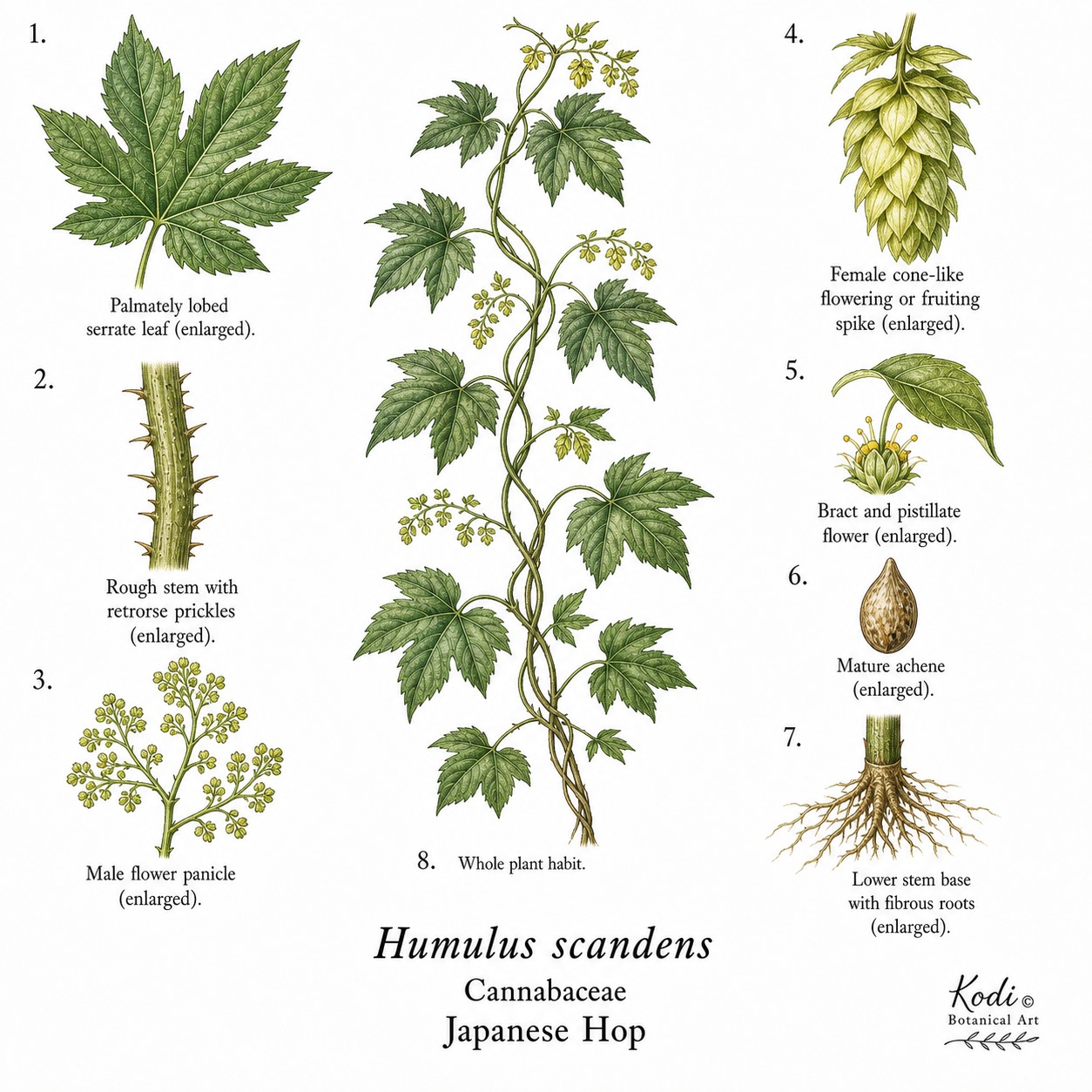
Known in TCM as Lü Cao (葎草), this bitter and sweet, cold herb enters the Lung, Large Intestine, and Kidney. Traditionally, it clears Heat and resolves toxicity, most often applied for dysentery, upper respiratory infection, and urinary tract infection. Modern research has identified Luteolin-7-O-β-D-glucoside among its active constituents.
Part used: Whole herb
Also Known As
Latin: Herba Humuli Scandentis | Pinyin: Lü Cao | Chinese: 葎草
TCM Properties
- Taste
- bitter, sweet
- Temperature
- cold
- Channels
- Lung, Large Intestine, Kidney
Traditional Use
Primary Actions
- Clears Heat and resolves toxicity
- Promotes urination and reduces oedema
- Clears Lung Heat and suppresses cough
- Stops dysentery and treats intestinal heat
Secondary Actions
- Antipruritic … clears Damp-Heat from the skin (eczema, urticaria)
- Used in folk medicine for pulmonary tuberculosis and chronic colitis
Classical References
- Ben Cao Gang Mu Shi Yi (Zhao Xuemin, Qing dynasty): lists Lü Cao (葎草) for treating hematuria, strangury, snake and scorpion bites, and sores … consistent with its heat-clearing, urinary-promoting profile
- Widely documented in Chinese folk medicine of northern and northeastern China for tuberculosis and dysentery; related to brewing hop (Humulus lupulus) but distinct species with different phytochemical and pharmacological profile
Modern Research
Active Compounds
- Luteolin-7-O-β-D-glucoside (LGL; principal anti-inflammatory flavonoid)
- Apigenin-7-O-β-D-glucoside (AGL; antipruritic flavonoid)
- Friedelanone (triterpenoid)
- Epifriedelanol (triterpenoid)
- cis-Asarone
- Stigmasta-4-ene-3,6-dione
- γ-Sitosterol
- n-Hexadecanoic acid and linoleic acid
Studied Effects
- Immunosuppressive: extract significantly inhibited splenocyte proliferation induced by ConA, LPS, and MLR; suppressed CD4+ T cell activation and IFN-γ production via Erk1/2 and P38 MAPK pathway inhibition … supports use in autoimmune-inflammatory Bi syndrome (PMID 25004883)
- Antipruritic: 40% ethanol fraction inhibited rat peritoneal mast cell degranulation and antigen-stimulated histamine release, and reduced serum IL-4 in murine allergy models; luteolin-7-O-glucoside and apigenin-7-O-glucoside identified as active antipruritic flavonoids (PMID 20619323)
- Pharmacological review (TCMSP database analysis) confirms anti-inflammatory, antioxidant, hepatoprotective, lipid-lowering, antimicrobial, anti-tumour, and neuroprotective activities across gastrointestinal, respiratory, urinary, and cardiovascular systems
PubMed References
Safety & Interactions
Contraindications
- Cold-Damp diarrhea or dysentery without Heat signs
- Spleen-Stomach Deficiency Cold
Cautions
- Standard dose 10–15g decoction; 30–60g fresh herb
- Immunosuppressive activity documented in vitro and in vivo; caution in patients on immunosuppressive therapy (potential additive effect) or with known immunodeficiency
- Not to be confused with Humulus lupulus (brewing hops) … different species with distinct phytochemistry
Drug Interactions
- Immunosuppressants: preclinical immunosuppressive activity via T-cell inhibition; potential additive effect with pharmaceutical immunosuppressants
Conditions
- Dysentery Traditional ★★★☆☆ JSON
- Upper Respiratory Infection Traditional ★★★☆☆ JSON
- Urinary Tract Infection Traditional ★★★☆☆ JSON
- Urticaria Research ★★★☆☆ JSON
- Edema Traditional ★★☆☆☆ JSON
Frequently Asked Questions
What is Japanese Hop used for?
Japanese Hop is traditionally used to Clears Heat and resolves toxicity, Promotes urination and reduces oedema, Clears Lung Heat and suppresses cough, Stops dysentery and treats intestinal heat. Research has investigated its effects on: Immunosuppressive: extract significantly inhibited splenocyte proliferation induced by ConA, LPS, and MLR; suppressed CD4+ T cell activation and IFN-γ production via Erk1/2 and P38 MAPK pathway inhibition … supports use in autoimmune-inflammatory Bi syndrome (PMID 25004883); Antipruritic: 40% ethanol fraction inhibited rat peritoneal mast cell degranulation and antigen-stimulated histamine release, and reduced serum IL-4 in murine allergy models; luteolin-7-O-glucoside and apigenin-7-O-glucoside identified as active antipruritic flavonoids (PMID 20619323).
What are other names for Japanese Hop?
Japanese Hop is also known as Humuli. In TCM: 葎草 (Lü Cao); Herba Humuli Scandentis.
Is Japanese Hop safe during pregnancy?
The safety of Japanese Hop during pregnancy has not been established. Consult a qualified healthcare provider before use.
What are the contraindications for Japanese Hop?
Japanese Hop should not be used in: Cold-Damp diarrhea or dysentery without Heat signs; Spleen-Stomach Deficiency Cold. Consult a qualified healthcare provider before use.
Does Japanese Hop interact with any medications?
Japanese Hop may interact with: Immunosuppressants: preclinical immunosuppressive activity via T-cell inhibition; potential additive effect with pharmaceutical immunosuppressants. Always inform your healthcare provider of any herbal supplements you are taking.