Gold Coin Grass
- Chinese
- 过路黄
- Pinyin
- Guo Lu Huang
- Latin
- Herba Lysimachiae
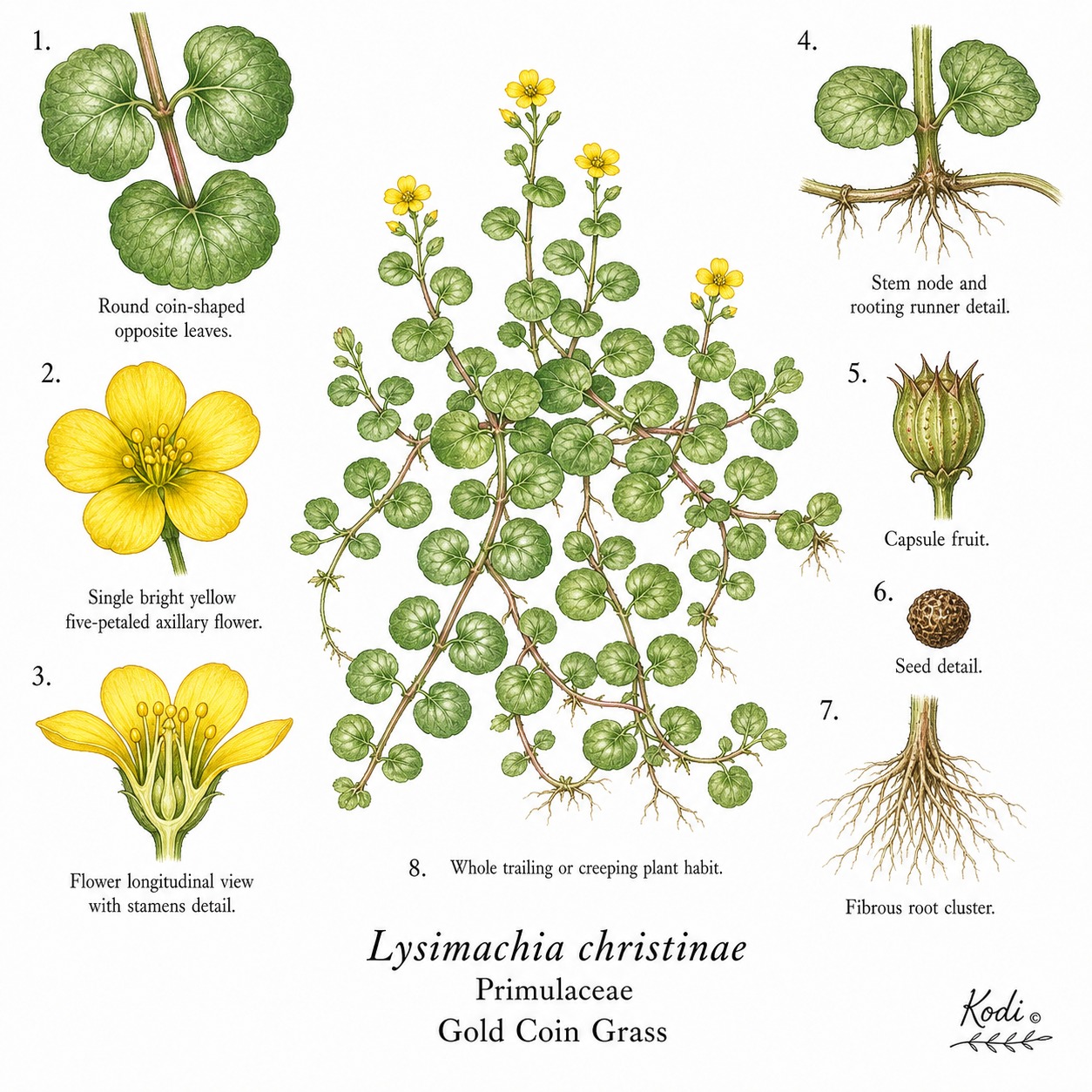
Known in TCM as Guo Lu Huang (过路黄), this sweet and salty, cool herb enters the Liver, Gallbladder, Kidney, and Bladder. Traditionally, it clears Damp-Heat and promotes urination, most often applied for nephrolithiasis, urinary tract infection, and hepatitis. Modern research has identified Rutin among its active constituents.
Part used: Whole herb
Also Known As
Latin: Herba Lysimachiae | Pinyin: Guo Lu Huang | Chinese: 过路黄
TCM Properties
- Taste
- sweet, salty
- Temperature
- cool
- Channels
- Liver, Gallbladder, Kidney, Bladder
Traditional Use
Primary Actions
- Clears Damp-Heat and promotes urination
- Expels kidney and bladder stones … primary indication
- Clears Liver-Gallbladder Damp-Heat and dissolves gallstones
- Clears Heat and resolves toxicity
Secondary Actions
- Reduces jaundice and promotes bile flow in cholecystitis and hepatitis
- Anti-inflammatory for lower urinary tract
Classic Formulas
- Shi Lin Tong (石淋通) … patent formula using Jin Qian Cao (Guo Lu Huang) as the principal herb to dissolve urinary stones and relieve painful urination
- Combined with Hai Jin Sha (海金沙) and Qu Mai (瞿麦) in classical stone-expelling prescriptions for kidney and bladder calculi
Classical References
- Pharmacopoeia name 金钱草 (Jin Qian Cao, Gold Coin Grass) derives from the round coin-shaped leaves; 过路黄 (Guo Lu Huang, Yellow Roadside Herb) is the folk vernacular for the same plant Lysimachia christinae Hance
- Stone-dissolving use recorded in Song dynasty formularies; incorporated into Shi Lin (石淋, stone strangury) treatment lineage
Modern Research
Active Compounds
- Rutin (quercetin-3-O-rutinoside; 3.36 mg/g in crude extract)
- Quercetin (0.83 mg/g)
- Kaempferol (0.86 mg/g)
- Hyperoside (quercetin-3-galactoside)
- Isoquercetin
- Chlorogenic acid
Studied Effects
- Anti-urolithiasis: aqueous extract eliminated preestablished cholesterol gallstones almost entirely after 2–4 weeks of treatment in mice … dose- and duration-dependent regression (PMID 25794804)
- Gallstone prevention via gut microbiota: aqueous extract prevents cholesterol gallstone formation in high-fat-diet mice by favourably altering intestinal microflora composition, reducing total cholesterol and bile acid excretion (PMID 34261853)
- Nephrolithiasis mechanisms: network pharmacology identified 16 active compounds and 11 key targets including purine salvage, IL-4/IL-13 signalling, and neutrophil degranulation pathways as mechanisms for kidney stone inhibition (PMID 32241963)
PubMed References
- Lysimachia christinae Hance regresses preestablished cholesterol gallstone in mice (2015)
- Aqueous extract of Lysimachia christinae Hance prevents cholesterol gallstone by affecting intestinal microflora (2021)
- Network pharmacology study on mechanisms of Christina Loosestrife for treatment of nephrolithiasis (2020)
Safety & Interactions
Contraindications
- Cold-Damp patterns of the Kidney and Bladder
- Spleen-Stomach Deficiency Cold
Cautions
- Standard dose 15–60g decoction (higher than most herbs … bulk action required for stone dissolution)
- Long-term use at high doses may cause loose stools or diarrhea; reduce dose if this occurs
- Stone expulsion should be monitored; large stones may require concurrent medical management
Conditions
- Nephrolithiasis Research ★★★★★ JSON
- Urinary Tract Infection Traditional ★★★☆☆ JSON
- Hepatitis Traditional ★★★☆☆ JSON
- Hypertension Traditional ★★☆☆☆ JSON
- Edema Traditional ★★★☆☆ JSON
Frequently Asked Questions
What is Gold Coin Grass used for?
Gold Coin Grass is traditionally used to Clears Damp-Heat and promotes urination, Expels kidney and bladder stones … primary indication, Clears Liver-Gallbladder Damp-Heat and dissolves gallstones, Clears Heat and resolves toxicity. Research has investigated its effects on: Anti-urolithiasis: aqueous extract eliminated preestablished cholesterol gallstones almost entirely after 2–4 weeks of treatment in mice … dose- and duration-dependent regression (PMID 25794804); Gallstone prevention via gut microbiota: aqueous extract prevents cholesterol gallstone formation in high-fat-diet mice by favourably altering intestinal microflora composition, reducing total cholesterol and bile acid excretion (PMID 34261853).
What are other names for Gold Coin Grass?
Gold Coin Grass is also known as Lysimachia. In TCM: 过路黄 (Guo Lu Huang); Herba Lysimachiae.
Is Gold Coin Grass safe during pregnancy?
The safety of Gold Coin Grass during pregnancy has not been established. Consult a qualified healthcare provider before use.
What are the contraindications for Gold Coin Grass?
Gold Coin Grass should not be used in: Cold-Damp patterns of the Kidney and Bladder; Spleen-Stomach Deficiency Cold. Consult a qualified healthcare provider before use.