Fineleaf Schizonepeta Herb
- Chinese
- 荆芥
- Pinyin
- Jing Jie
- Latin
- Herba Schizonepetae
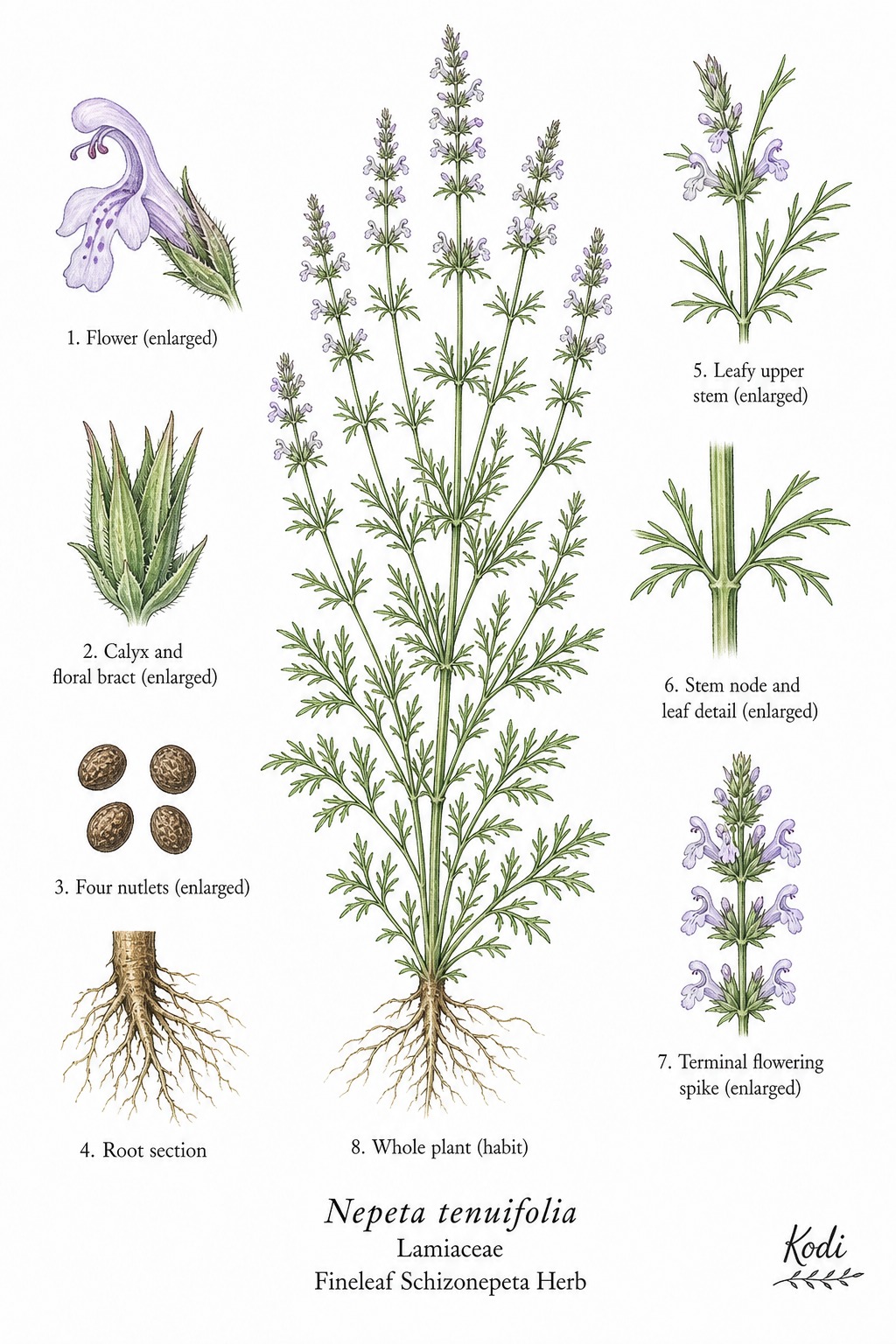
Known in TCM as Jing Jie (荆芥), this acrid, slightly warm herb enters the Lung and Liver. Traditionally, it releases exterior and disperses wind, most often applied for wind heat, wind cold, and common cold. Modern research has identified Pulegone among its active constituents.
Part used: Whole herb
Also Known As
Latin: Herba Schizonepetae | Pinyin: Jing Jie | Chinese: 荆芥
TCM Properties
- Taste
- acrid
- Temperature
- slightly warm
- Channels
- Lung, Liver
Traditional Use
Primary Actions
- Releases exterior and disperses wind … uniquely effective for both wind-cold and wind-heat patterns; mild warm nature allows use across exterior syndromes with fever, chills, headache, and body aches
- Vents rashes and relieves itching … treats measles with incomplete eruption, urticaria, eczema, and chronic skin itching from wind; one of the most important herbs for wind-type skin conditions
- Clears early-stage sores and carbuncles … disperses wind-heat accumulation before pus formation; resolves swelling and redness at skin surface
Secondary Actions
- Hemostatic when charred (Jing Jie Tan 荆芥炭) … transformed from dispersing to astringent by charring; used for uterine bleeding, bloody stool, and epistaxis from heat or wind
- Treats throat pain and swelling … combined with Bo He and Niu Bang Zi for wind-heat sore throat and early-stage tonsillar swelling
- Dispels wind from postpartum exhaustion … classical use for postpartum spasm, tetanus, and convulsion from wind entering blood deficiency
Classic Formulas
- Jing Fang Bai Du San (荆防败毒散) … paired with Fang Feng as primary exterior-releasing duo; addresses wind-cold-damp exterior syndrome with headache, stiff neck, fever, and body aches
- Xiao Feng San (消风散) … combined with Fang Feng, Ku Shen, Chan Tui for wind-heat skin disease with pronounced itching and weeping eczema
- Yin Qiao San (银翘散, Wu Jutong, 1798) … Jing Jie added to wind-heat formula to strengthen surface-opening and mild dispersing; bridges cold and warm exterior-releasing herbs
- Huai Hua San (槐花散) … charred Jing Jie with Huai Hua for blood in stool and dysentery from Large Intestine heat
Classical References
- Bencao Jing Shu (本草经疏, Miao Xiyong, 1625) … 'Jing Jie is the foremost herb for wind; its flavour is acrid, its nature is warm and upward-moving; it enters the Lung and Liver, where it opens the exterior and disperses stagnation'
- Bencao Gangmu (本草纲目, Li Shizhen, 1578) … distinguishes whole herb (Jing Jie) from spike (Jing Jie Sui); notes the spike is more fragrant and appropriate for venting rashes and stopping bleeding when charred
- Wen Re Jing Wei (温热经纬, Wang Mengying, 1852) … Jing Jie as a 'bridge herb' suitable in early-stage warm disease due to its mild nature, unlike strong diaphoretics
Modern Research
Active Compounds
- Pulegone (major volatile oil, 25–55% in stem and leaf)
- Menthone
- Isomenthol
- d-Limonene
- Hesperidin
- Luteolin
- Luteolin-7-O-glucoside
- Rosmarinic acid
- Caffeic acid
- Apigenin
- Acacetin
Studied Effects
- Anti-inflammatory … hesperidin inhibits NF-κB and MAPK pathways, reduces TNF-α and IL-1β in LPS-induced RAW264.7 macrophages; pulegone suppresses COX-2 and iNOS (PMID 28629816)
- Antipyretic and diaphoretic … volatile oil fraction promotes perspiration and reduces rectal temperature in febrile animal models; mechanism consistent with classical wei-level dispersing action
- Antihistaminic and anti-pruritic … flavonoid fraction inhibits IgE-mediated mast cell degranulation and histamine release; clinical correlation to urticaria and atopic dermatitis applications (PMID 26774946)
- Antimicrobial … essential oil demonstrates activity against Staphylococcus aureus, Streptococcus pyogenes, Candida albicans; MIC values clinically relevant for skin and throat infections
- Hemostatic (charred form) … Jing Jie Tan significantly reduces PT and APTT, increases platelet aggregation in vivo; tannin content post-charring confirmed as primary mechanism (PMID 24847832)
- Neuroprotective (preliminary) … rosmarinic acid fraction shows attenuation of LPS-induced neuroinflammation in BV2 microglia; potential relevance to wind-type neurological applications
PubMed References
Safety & Interactions
Contraindications
- Spontaneous perspiration or night sweats from yin or wei-qi deficiency … acrid dispersing nature will further open the surface and drain protective qi
- Internal fire without exterior pathogen … mild warm nature contraindicated in pure interior heat, liver yang rising, or yin-deficiency heat conditions
Cautions
- The charred form (Jing Jie Tan) is pharmacologically distinct from raw Jing Jie … raw form disperses exterior, charred form arrests bleeding; verify correct preparation before dispensing
- Standard decoction dose 3–9 g is safe and well-tolerated; high doses of volatile oil in isolation may cause nausea or dizziness
- Short decoction recommended … add in the final 5–10 minutes to preserve volatile oil content; prolonged boiling significantly reduces efficacy
- Generally compatible with most TCM herbs; no clinically significant drug interactions documented in standard decoction doses
Classic formulas that use Fineleaf Schizonepeta Herb
Herbs are rarely taken alone in Chinese medicine. These formula pages show what this herb does inside a classic prescription and which pattern that prescription is chosen for.
Conditions
- Wind Heat Traditional ★★★★☆ JSON
- Wind Cold Traditional ★★★★☆ JSON
- Common Cold Traditional ★★★★☆ JSON
- Uterine Bleeding Traditional ★★★☆☆ JSON
Frequently Asked Questions
What is Fineleaf Schizonepeta Herb used for?
Fineleaf Schizonepeta Herb is traditionally used to Releases exterior and disperses wind … uniquely effective for both wind-cold and wind-heat patterns; mild warm nature allows use across exterior syndromes with fever, chills, headache, and body aches, Vents rashes and relieves itching … treats measles with incomplete eruption, urticaria, eczema, and chronic skin itching from wind; one of the most important herbs for wind-type skin conditions, Clears early-stage sores and carbuncles … disperses wind-heat accumulation before pus formation; resolves swelling and redness at skin surface. Research has investigated its effects on: Anti-inflammatory … hesperidin inhibits NF-κB and MAPK pathways, reduces TNF-α and IL-1β in LPS-induced RAW264.7 macrophages; pulegone suppresses COX-2 and iNOS (PMID 28629816); Antipyretic and diaphoretic … volatile oil fraction promotes perspiration and reduces rectal temperature in febrile animal models; mechanism consistent with classical wei-level dispersing action.
What are other names for Fineleaf Schizonepeta Herb?
Fineleaf Schizonepeta Herb is also known as Schizonepeta. In TCM: 荆芥 (Jing Jie); Herba Schizonepetae.
Is Fineleaf Schizonepeta Herb safe during pregnancy?
The safety of Fineleaf Schizonepeta Herb during pregnancy has not been established. Consult a qualified healthcare provider before use.
What are the contraindications for Fineleaf Schizonepeta Herb?
Fineleaf Schizonepeta Herb should not be used in: Spontaneous perspiration or night sweats from yin or wei-qi deficiency … acrid dispersing nature will further open the surface and drain protective qi; Internal fire without exterior pathogen … mild warm nature contraindicated in pure interior heat, liver yang rising, or yin-deficiency heat conditions. Consult a qualified healthcare provider before use.