All-Grass of Entire Meconopsis
- Chinese
- 全缘叶绿绒蒿
- Pinyin
- Quan Yuan Ye Lv Rong Hao
- Latin
- Herba Meconopsidis Integrifoliae
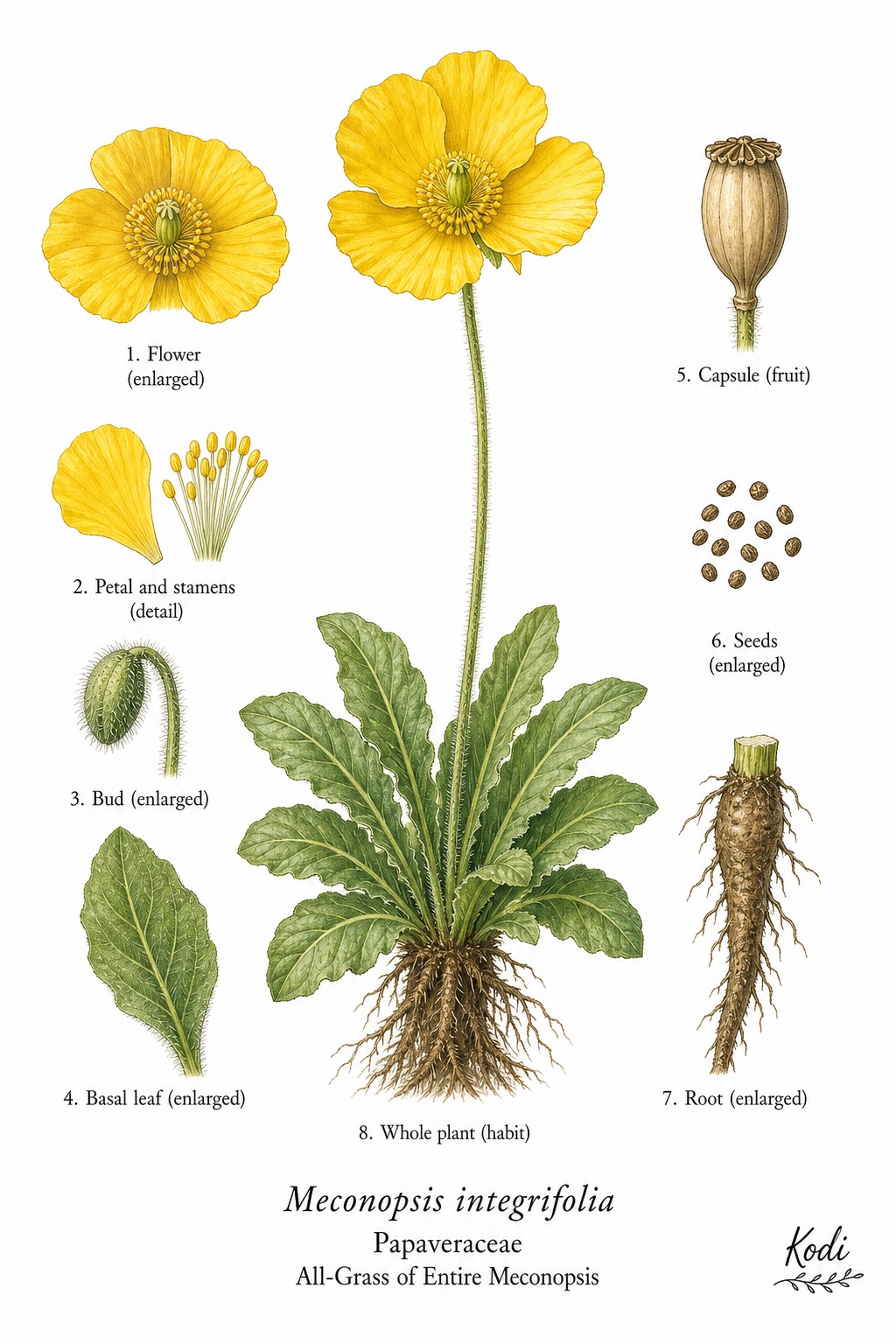
Known in TCM as Quan Yuan Ye Lv Rong Hao (全缘叶绿绒蒿), this bitter, cold herb enters the Lung and Liver. Traditionally, it clears heat and resolves toxin; primary Tibetan medicine treatment for pneumonia, hepatitis, and febrile infectious conditions, most often applied for hepatitis, pneumonia, and nafld. Modern research has identified Quercetin among its active constituents.
Part used: Whole herb
Also Known As
Latin: Herba Meconopsidis Integrifoliae | Pinyin: Quan Yuan Ye Lv Rong Hao | Chinese: 全缘叶绿绒蒿
TCM Properties
- Taste
- bitter
- Temperature
- cold
- Channels
- Lung, Liver
Traditional Use
Primary Actions
- Clears heat and resolves toxin; primary Tibetan medicine treatment for pneumonia, hepatitis, and febrile infectious conditions
- Reduces inflammation and alleviates pain; used for headaches, edema, and inflammatory swelling
- Supports Liver and cools blood; hepatoprotective application in liver heat and toxic patterns
Secondary Actions
- Clears Lung heat and stops cough; treats heat-type respiratory conditions with thick yellow phlegm
- Modern adjunct for NAFLD … improves hepatic lipid metabolism and reduces hepatic steatosis
- Potential anticancer application … induces apoptosis in leukaemia cell lines via mitochondrial pathway
Classic Formulas
- Shi Wei Gan Ning San (十味甘宁散) … Tibetan formula of ten herbs for chronic liver fibrosis and hepatitis; M. integrifolia is one of seven principal herbs
Classical References
- Traditional Tibetan materia medica … honoured as one of the 'Four Divine Herbs' (bzhi thang) for its profound heat-clearing and detoxifying properties; Tibetan name: ga bu lcan sog
- Qinghai-Tibet Plateau ethnomedicinal tradition … collected from high-altitude alpine meadows (3,000–5,000 m) and used fresh or dried for treating liver disease and pneumonia
Modern Research
Active Compounds
- Quercetin
- Luteolin
- Flavonol diglucosides (quercetin-3-O-glucosyl-glucoside series, four isolated compounds)
- Alkaloids (29 identified compounds in genus)
- Glycerophospholipids (48 identified compounds in genus)
- Arachidonic acid
- Linoleic acid
- Gamma-linolenic acid
Studied Effects
- Hepatoprotective … ethanolic extract significantly reduces ALT/AST in CCl4-induced liver injury models; restores antioxidant enzyme levels (PMID 23707208)
- Anti-NAFLD … ethyl acetate fraction reduces hepatic TG and LDL, inhibits lipid droplet deposition in HepG2 cells via AMPK/SREPB-1c/PPAR-α pathway (PMID 39795910)
- Anti-inflammatory … dose-dependent suppression of IL-1A, IL-1B, IL-6, and TNF; nitric oxide inhibition superior to blue-flowered Meconopsis (PMC11509530)
- Antioxidant … elevates glutathione, restores superoxide dismutase activity in oxidative stress models
- Anticancer … induces mitochondria-mediated apoptosis and G2/M cell cycle arrest in K562 leukaemia cells with low toxicity to normal cells (PMID 26133762)
PubMed References
- Investigation of Active Components of Meconopsis integrifolia (Maxim.) Franch in Mitigating Non-Alcoholic Fatty Liver Disease (2025)
- In vitro and in vivo hepatoprotective and antioxidant activity of ethanolic extract from Meconopsis integrifolia (Maxim.) Franch (2013)
- Induction of Mitochondrial Dependent Apoptosis in Human Leukemia K562 Cells by Meconopsis integrifolia: A Species from Traditional Tibetan Medicine (2015)
- Separation and purification of four flavonol diglucosides from the flower of Meconopsis integrifolia by high-speed counter-current chromatography (2015)
Safety & Interactions
Contraindications
- Cold or deficiency-cold patterns (Spleen-Stomach cold, yang deficiency) … cold thermal nature may aggravate deficiency conditions
- Hypersensitivity to Papaveraceae family … although non-psychoactive, cross-reactivity within the family is possible
Cautions
- No clinically documented drug interactions identified at time of review; monitoring advised when combined with hepatic drugs given liver-active constituents
- Alkaloid content warrants caution with prolonged high-dose use; standard decoction quantities are considered safe in traditional practice
- High-altitude endemic herb … verify sourcing and species identification, as Meconopsis genus contains multiple species with different alkaloid profiles
Conditions
- Hepatitis Research ★★★★☆ JSON
- Pneumonia Traditional ★★★☆☆ JSON
- Nafld Preclinical ★★★☆☆ JSON
- Bronchitis Traditional ★★★☆☆ JSON
- Liver Qi Stagnation Traditional ★★☆☆☆ JSON
Frequently Asked Questions
What is All-Grass of Entire Meconopsis used for?
All-Grass of Entire Meconopsis is traditionally used to Clears heat and resolves toxin; primary Tibetan medicine treatment for pneumonia, hepatitis, and febrile infectious conditions, Reduces inflammation and alleviates pain; used for headaches, edema, and inflammatory swelling, Supports Liver and cools blood; hepatoprotective application in liver heat and toxic patterns. Research has investigated its effects on: Hepatoprotective … ethanolic extract significantly reduces ALT/AST in CCl4-induced liver injury models; restores antioxidant enzyme levels (PMID 23707208); Anti-NAFLD … ethyl acetate fraction reduces hepatic TG and LDL, inhibits lipid droplet deposition in HepG2 cells via AMPK/SREPB-1c/PPAR-α pathway (PMID 39795910).
What are other names for All-Grass of Entire Meconopsis?
All-Grass of Entire Meconopsis is also known as Meconopsidis. In TCM: 全缘叶绿绒蒿 (Quan Yuan Ye Lv Rong Hao); Herba Meconopsidis Integrifoliae.
Is All-Grass of Entire Meconopsis safe during pregnancy?
The safety of All-Grass of Entire Meconopsis during pregnancy has not been established. Consult a qualified healthcare provider before use.
What are the contraindications for All-Grass of Entire Meconopsis?
All-Grass of Entire Meconopsis should not be used in: Cold or deficiency-cold patterns (Spleen-Stomach cold, yang deficiency) … cold thermal nature may aggravate deficiency conditions; Hypersensitivity to Papaveraceae family … although non-psychoactive, cross-reactivity within the family is possible. Consult a qualified healthcare provider before use.